FIFA World Cup 2026 Final Prediction: Who Reaches the Biggest Stage?
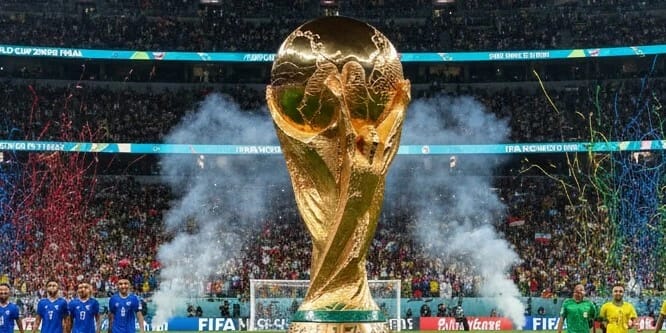

The 2026 FIFA World Cup final isn’t just another match-it’s the end point of the longest and most demanding tournament structure we’ve ever seen. With 48 teams and 104 matches, this edition will stretch squads, tactics, and endurance to their absolute limits. The final is scheduled to take place at MetLife Stadium in New York/New Jersey, a venue with over 82,000 capacity, making it the largest stage of the tournament If you’re looking for a 2026 FIFA World Cup final prediction, you can’t rely on surface-level analysis. For a complete tournament-wide breakdown including team strengths and knockout scenarios, explore our FIFA World Cup 2026 Prediction guide. You need to understand how teams survive the journey.
At Ez Tips, we believe in looking past the hype to the hard data. Here’s the truth most people miss: reaching the final will be less about raw talent and more about who can handle fatigue, rotation, and pressure over the expanded tournament bracket. The final will not reward flashy teams; it will reward teams built for survival. Every World Cup final presents a unique pressure environment where even small mistakes can decide the outcome. That’s where the real edge lies if you want to ensure your read on the tournament is sharp and not just guesswork.
How the 2026 Format Changes the Final Outcome
The format shift changes everything. Twelve groups, top two plus eight third-placed teams, and a full Round of 32 knockout stage. That means every finalist must win four knockout matches after the group stage—with almost no margin for error.
More matches don’t just mean more football,they mean more injuries, more rotation, and more tactical compromises. Teams will arrive at the final carrying physical and mental fatigue. You can already see how this impacts a 2026 FIFA World Cup final match prediction,the winner is likely the team that managed minutes better across the tournament.
Travel is another factor most people ignore. This World Cup spans USA, Canada, and Mexico, meaning long flights between matches. Teams could travel thousands of miles between fixtures, which is significantly higher than previous World Cups held in a single country. That travel load adds another layer of fatigue. This creates a unique scenario where squad rotation becomes just as important as starting quality. The team that adapts best to this schedule will carry a serious advantage into the final. It’s not glamorous, but it’s decisive.
Tactical Breakdown of Key Contenders
As we move toward the final stages of the 2026 FIFA World Cup, the tactical identities of the top teams have reached their peak evolution. Analyzing these contenders is not just about identifying star power; it is about understanding the "structural efficiency" that allows them to survive a 48-team bracket.
- Spain: The Vertical Tik-Taka
- Under Luis de la Fuente, Spain has discarded "possession for possession's sake." Their current tactical DNA is built on high-intensity counter-pressing and explosive width. By utilizing Lamine Yamal and Nico Williams, they create a "dual-threat" system that stretches opposition defenses horizontally, allowing midfielders like Pedri and Rodri to exploit the vertical lanes. Their 4-3-3 is now more direct, moving from defense to attack in fewer than four passes.
- England: The Pragmatic Powerhouse
- The Three Lions have adopted a "Hybrid Box" midfield under their recent leadership. This tactical shift focuses on defensive stability and "rest-defense," ensuring that even when they commit men forward, they are never exposed to the counter-attack. With Jude Bellingham acting as the late-arriving threat, England’s game plan revolves around controlled territorial dominance and high-efficiency set-piece execution.
- Brazil: The "Organized Chaos"
- Brazil’s 2026 system is defined by "Functional Play"—grouping players on one side of the pitch to draw the defense in, before a rapid diagonal switch to an isolated winger. This creates constant 1v1 mismatches. Their defensive transition is now anchored by a double-pivot that provides the safety net for their five-man attacking rotation.
Dark Horses That Could Disrupt the Final
The expanded 104-match format has created a unique environment where teams with superior physical conditioning and collective discipline can topple traditional giants.
- Japan (The Collective Machine): Japan has emerged as the premier "Giant Killer." Their tactical synergy resembles a cohesive club team rather than a national side. Using a sophisticated mid-block trap, they lure favorites into the center of the pitch before launching high-speed transitions through Kaoru Mitoma. Their win over England in March 2026 proved they have the tactical maturity to reach the final.
- Norway (The Haaland Factor): With Erling Haaland and Martin Ødegaard providing a world-class spine, Norway is the ultimate "High-Variance" dark horse. They utilize a direct 4-4-2 that focuses on low-crosses and physical duels. They don't need 60% possession to win; they only need one opening for Haaland to change the odds.
- Ecuador (The Defensive Wall): Ecuador is arguably the most difficult team to score against in 2026. Their gritty, robust 5-4-1 system conceded only five goals throughout the entire qualifying campaign. Led by Moisés Caicedo, they are the masters of the 1–0 victory and the penalty shootout, making them a nightmare opponent in the knockout rounds.
Match Analysis: Spain vs. France Final
A hypothetical final between Spain and France at the MetLife Stadium on July 19th would represent the "Gold Standard" of modern football-a clash between Positional Dominance and Clinical Pragmatism.
1. The Strategic Blueprint
- Spain: Will aim to dictate the tempo, utilizing a high defensive line to compress the pitch. Their goal is to keep the ball in France’s half, using Rodri to recycle possession and prevent France from settling into a rhythm.
- France: Will likely adopt a "reactive" stance. Didier Deschamps’ blueprint is built on a mid-block that denies space between the lines. They are comfortable without the ball, waiting for the one Spanish turnover that allows Mbappé to exploit the space behind a high-line defense.
2. The Critical Matchups
- Lamine Yamal vs. Theo Hernández: This is the game's decisive battle. If Yamal can pin Theo back, Spain can isolate France’s center-backs. However, if Theo wins the duel, he becomes the primary outlet for France’s counter-attacks.
- Rodri vs. Antoine Griezmann: Griezmann’s role as the "connector" is vital. Rodri must neutralize Griezmann’s movement between the midfield and defensive lines to cut off the supply to France’s forwards.
3. The "X-Factor" and Prediction
Spain has the edge in creative volume, often creating 4–5 "Big Chances" per match. However, France possesses clinical efficiency,they often score from their first clear opening. In a final of this magnitude, the match often descends into a "Tactical Chess Match" where the first goal dictates everything.
Ez Tips Final Verdict: Spain represents the best betting sites favorite for their control, but France is the "Sharp" choice for their ability to win even when playing "ugly."
Historical Trends That Shape Every World Cup Final
1. The "Elite Eight" Monopoly
History proves that the World Cup is an exclusive club. Despite dozens of nations competing, only eight countries have ever lifted the trophy in nearly a century of play. Furthermore, the last six World Cup winners have hailed exclusively from Europe or South America.
- The Stat: Since the tournament’s inception in 1930, 100% of titles have been won by these two continents.
- The Trend: While the 48-team expansion in 2026 invites more diversity, history suggests the "Heavyweights" (Brazil, Germany, Argentina, France, Italy, England, Spain, and Uruguay) maintain a psychological and tactical stranglehold on the final match.
2. The "One-Goal" Razor’s Edge
The common misconception is that a final is a showcase of attacking flair. The reality is far more conservative. Finals are rarely open or chaotic; they are tight, controlled, and calculated affairs defined by defensive resilience.
- The Stat: 80% of the last five finals (2006, 2010, 2014, 2022) were decided by a single goal or a penalty shootout.
- The Trend: In high-stakes environments, teams prioritize "not losing" over "winning big." This is why a football odds comparison for the final often favors the "Under 2.5 Goals" market. Success in 2026 will reward the side that can maintain focus for 120 minutes without a single lapse in concentration.
3. The Power of "Systemic Depth"
France reaching back-to-back finals in 2018 and 2022 highlights a critical shift in modern football: elite squads with systemic depth repeat deep runs. This isn't about one "Golden Generation"-it’s about national programs that consistently produce high-level talent across every position.
- The Stat: France has reached the final in 3 of the last 7 World Cups, a 42% appearance rate since 1998.
- The Trend: In a grueling 104-match schedule, the final will be won by the team whose 23rd player is as tactically prepared as their 1st. When searching for the best betting offers to place your futures, look for teams with "Elite Tier" youth integration and squad rotation capabilities.
Path to the Final: Why Bracket Position Matters More Than Team Strength
Here’s where most predictions go wrong. People focus on team quality but ignore the bracket. In reality, the path to the final can be harder than the final itself.
A team might face multiple top-ranked opponents before even reaching the semifinal. In past tournaments, some finalists have faced two or more top-10 ranked teams before the semifinal stage, while others benefited from significantly easier paths. Another might get a smoother route due to group positioning. That imbalance directly affects your 2026 FIFA World Cup final match winner prediction.
Add travel into the equation, and things get even more uneven. A team traveling coast-to-coast across North America will burn more energy than one playing in a tighter region cluster. Over seven matches, that difference compounds. The smartest prediction isn’t about picking the best team—it’s about identifying the team with the most efficient path.
Tactical Evolution Expected in the 2026 Final
If you’re expecting a goal fest in the final, think again. Historically, finals average around two goals or fewer. In fact, 4 of the last 5 World Cup finals finished with under 3 total goals, showing how controlled and low-risk these matches usually are. Teams don’t take risks,they minimize mistakes. Only 2 of the last 6 World Cup finals were decided by more than a one-goal margin, reinforcing how cautious teams become at this stage.
Expect structured defensive setups, compact midfield control, and sharp transitions. Possession-heavy teams often struggle late in tournaments because they expend more energy controlling games. By the time the final arrives, efficiency matters more than dominance.
This is why any FIFA World Cup 2026 final match prediction must factor in tactical discipline. The team that controls space—not just the ball—will have the upper hand. It’s not always exciting, but it’s effective.
Predicted Finalists for FIFA World Cup 2026
When you filter everything—history, squad depth, tournament structure,a few teams stand out.
France remains the benchmark. France has reached 3 finals in the last 7 World Cups (2006, 2018, 2022), showing a level of tournament consistency no other nation currently matches. Their squad depth is unmatched, and they’ve proven they can handle tournament pressure. Brazil brings attacking quality and a new generation that could peak at the right time. Brazil has reached at least the quarterfinal stage in 7 of the last 8 World Cups, showing consistent deep tournament performance even when they don’t win. England has the talent, but their inconsistency in knockout matches remains a concern. England has won only one World Cup in history (1966), despite regularly entering tournaments with top-ranked squads.
Argentina’s core is aging, and while experience helps, the physical demands of a 48-team tournament could expose that weakness. This is where the prediction becomes sharper—you’re not just picking big names, you’re identifying teams built for endurance.
A realistic 2026 FIFA World Cup final prediction points toward a European powerhouse meeting a South American giant. That pattern has held for decades—and there’s no strong reason for it to break now.
FIFA World Cup 2026 Final Winner Prediction
After breaking everything down, one factor stands above the rest—depth under pressure.
France checks every box. They have midfield control, defensive structure, and attacking flexibility. More importantly, they have the ability to rotate without losing quality. In a long tournament, that is gold.
Brazil is close, but their defensive consistency in high-pressure matches is still a question. That slight edge is enough to tilt the 2026 FIFA World Cup final winner prediction.
Predicted Winner: France
If you want a deeper data-driven explanation behind this pick, including squad depth and historical trends, check our FIFA World Cup 2026 Winner Prediction.
It’s not a flashy pick,it’s a logical one. And logic is what wins in finals.
2026 FIFA World Cup Final Score Prediction
we believe the most accurate forecasts are built on the foundations of historical data. When looking at the 2026 FIFA World Cup final score prediction, we have to look at the "Scoreline DNA" of the world’s biggest game. Finals are rarely open, expansive matches; they are high-stakes tactical battles where risk-aversion is the primary strategy.
The Scoreline Trend: A Game of Inches
Recent history proves that the final is a game decided by the thinnest of margins:
- 2022: 3-3 (Decided on penalties)
- 2018: 4-2
- 2014: 1-0 (AET)
- 2010: 1-0 (AET)
- 2006: 1-1 (Decided on penalties)
The Reality Check: Excluding the anomaly of 2018, the trend is undeniable. Three of the last five finals required extra time or penalties to separate the sides. For any serious FIFA World Cup 2026 final winner prediction, expecting a cagey, controlled match is the only data-backed approach.
The Ez Tips Official Score Prediction
Predicted Score: France 2–1 Brazil
This scoreline is competitive, realistic, and reflects exactly how a modern final unfolds. Here is why this specific outcome is the "Sharp" play:
- France’s Clinical Edge: As seen in their previous runs, France does not need 20 shots to score twice. Their ability to strike in transition—even when being out-possessed—makes a two-goal tally highly probable.
- Brazil’s Defensive Discipline: Under their current structure, Brazil rarely collapses. A 2–1 result suggests a hard-fought contest where Brazil stays in the game until the final whistle but perhaps lacks the clinical finishing of the French machine in the dying minutes.
- Pattern Recognition: A 2–1 result covers the most frequent statistical outcomes in high-level UEFA vs. CONMEBOL matchups.
Strategic Betting Insight
If you are looking to place a wager on the "Correct Score" market, we recommend checking the best betting sites for "Scorecast" options that pair a 2–1 victory with a specific goalscorer like Kylian Mbappé or Vinícius Júnior. This maximizes your value while staying grounded in realistic tournament patterns rather than chasing unlikely blowouts.
Key Variables That Could Flip the Final Prediction
Even the strongest prediction isn’t immune to disruption. A single injury in the knockout rounds can shift the balance instantly. Squad depth helps, but losing a key player still matters.
VAR decisions have also played a role in recent finals. The 2018 final saw a VAR-awarded penalty for France, while the 2022 final featured multiple penalties, proving how decisive single calls can be on the biggest stage. One penalty, one call, and the entire match changes. That unpredictability is part of what makes World Cups so intense. To understand how betting markets price these teams and where real value exists beyond hype, read our World Cup 2026 Favorites Odds Analysis.
Then there’s extra time. The 2022 final went the full 120 minutes before penalties, and players showed visible fatigue, reinforcing how endurance becomes a deciding factor at this stage. Playing 120 minutes before penalties drains even elite players. The team that manages energy better across the tournament will have the advantage if the final goes the distance. These variables don’t break predictions—but they remind you to treat them with utmost realism.
Final Prediction Summary for FIFA World Cup 2026
The 2026 World Cup final will not be decided by hype or star power alone. It will come down to structure, depth, and efficiency over a long tournament. Each of these factors plays a unique role in shaping how the final unfolds.
- The expanded format increases fatigue
- History limits realistic winners
- Finals are typically tight and tactical
Put all of that together, and the picture becomes clear. A European powerhouse versus a South American giant, with the edge going to the team that handles pressure better.
Final Call: France to win a tightly contested final.
If you approach predictions this way-fact-based, structured, and realistic-you don’t just guess outcomes. You give yourself the best possible chance to stay ahead!
Last Updated:4th May,2026
Frequently Asked Questions
More blogs




Football Blogs