World Cup 2026 Round of 32 Qualification Rules Explained

Why the World Cup 2026 Round of 32 Qualification Rules Exist
The World Cup 2026 Round of 32 qualification rules are part of a major format change introduced by FIFA for the upcoming tournament. These structural changes can be better understood alongside FIFA World Cup records and statistics. For the first time in history, the FIFA World Cup will expand from 32 teams to 48 teams, creating the largest competition the tournament has ever seen. Because of this expansion, FIFA had to redesign how teams move from the group stage into the knockout rounds. This article also serves as a FIFA World Cup 2026 format explained guide, helping readers understand how the expanded tournament structure works from the group stage to the final.
World Cup 2026 Round of 32 Qualification Summary
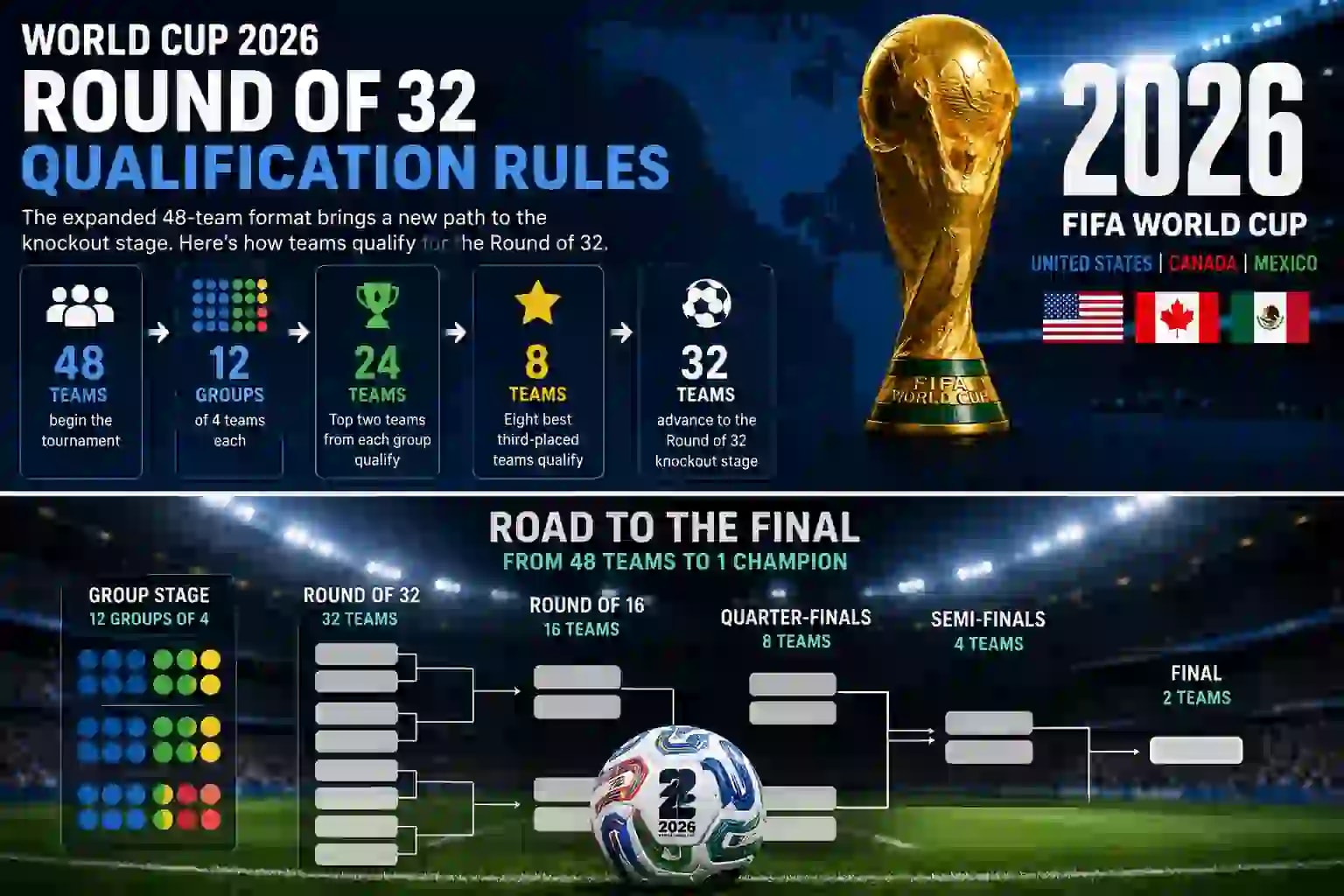
The World Cup 2026 Round of 32 qualification rules are simple once the group stage ends:
- 48 teams begin the tournament
- 12 groups of four teams each
- Top two teams from every group qualify (24 teams)
- Eight best third-placed teams also qualify
- Total of 32 teams advance to the Round of 32 knockout stage
Many fans ask how many teams advance to Round of 32 in 2026, and the answer is 32 teams including the top two from each group and the eight best third-placed teams.
This structure ensures the tournament moves smoothly from the group phase into the knockout bracket while maintaining utmost competitive balance.
Difference Between 2022 and 2026 World Cup Format
Under previous World Cup formats, the knockout stage started directly with the Round of 16. The 2026 edition introduces more teams and an additional knockout round, which creates a major structural change compared with the 2022 tournament. That system worked when only 32 teams participated. However, with 48 teams competing in 2026, the tournament structure needed an additional elimination stage. The Round of 32 qualification rules ensure that exactly 32 teams advance from the group stage into the knockout bracket, creating a balanced path toward the final.
FIFA approved this expanded format in 2017 after years of discussion about increasing participation from more football regions. Many competitive national teams regularly missed World Cup qualification despite strong performances. Expanding the tournament helps ensure wider global representation while maintaining competitive balance with utmost fairness.
Another reason behind the change is tournament scale. The 2026 World Cup will include 104 matches, significantly more than previous tournaments. Introducing a Round of 32 creates a logical transition between the group phase and the later knockout rounds.
Understanding these qualification rules is important because they determine exactly how teams move from the group stage into the first knockout round of the competition.
How the 48 Team Group Stage Determines World Cup 2026 Round of 32 Qualification
To understand the World Cup 2026 Round of 32 qualification rules, it is important to first understand how the 48-team group stage works. Every team that qualifies for the tournament begins its campaign in this phase, and the final group standings determine which nations advance to the first knockout round.
The 2026 World Cup will feature 48 teams divided into 12 groups, with four teams in each group. This is often described as the FIFA World Cup 2026 format: 12 groups of four explained, which defines how teams are structured in the opening stage. Fans who want to follow match results and group standings during the tournament can monitor games through our FIFA World Cup live score page. Each team plays three matches, facing every other team in its group once. This structure keeps the familiar round-robin style used in previous tournaments while expanding the number of participating nations.
The standard FIFA points system remains unchanged. Teams earn three points for a win, one point for a draw, and zero points for a loss. After all three matchdays are completed, teams in each group are ranked according to the total number of points they collected. The group table then determines which teams move closer to qualifying under the World Cup 2026 Round of 32 qualification rules.
If two or more teams finish with the same number of points, FIFA applies a sequence of tiebreakers to determine the final ranking. The most important criteria include goal difference, total goals scored, and head-to-head results between the tied teams. If teams remain level after these measures, additional rules such as fair play points may be used to separate them.
The group stage plays a decisive role in determining which teams remain in the tournament. Finishing near the top of the group table greatly improves a team’s chances of progressing. However, the expanded format also allows teams finishing in third place to remain competitive in the qualification race. This also influences World Cup group stage exit predictions for several teams.
This structure helps ensure that strong teams are rewarded for consistent performance, while also giving competitive nations a unique opportunity to progress even if they narrowly miss second place. The exact method of qualification is defined by the World Cup 2026 Round of 32 qualification rules, which determine how many teams advance from the group stage and how the final 32-team knockout bracket is formed.
The next section explains exactly how teams qualify for the Round of 32, including the role played by group winners, runners-up, and the best third-placed teams.
How Teams Qualify Under the World Cup 2026 Round of 32 Qualification Rules
The World Cup 2026 Round of 32 qualification rules determine exactly how teams move from the group stage into the knockout bracket. Because the tournament now features 48 teams, FIFA needed a system that would reduce the field to 32 teams for the first elimination round.
Qualification is based entirely on the final standings in the 12 groups.
First, the top two teams from each group automatically qualify for the Round of 32. Since there are 12 groups, this produces:
12 groups × 2 teams = 24 teams
These teams advance directly to the knockout stage because they finished first or second in their group standings.
However, the expanded format also allows some third-place teams to progress. After the group stage ends, FIFA ranks the third-placed teams from all 12 groups. From this ranking, the eight best third-placed teams also qualify for the Round of 32.
The ranking of third-placed teams is determined using several criteria. These include points earned during the group stage, followed by goal difference, and then total goals scored. If teams remain level, additional factors such as fair play points may be used.
This system ensures that teams which perform strongly in competitive groups still have a realistic chance to advance. A team finishing third with strong results may qualify ahead of another third-place team with fewer points or a weaker goal difference.
In total, the qualification process produces:
- 24 teams from the top two positions in each group
- 8 teams from the best third-place rankings
This creates the 32 teams that form the Round of 32 knockout bracket. These qualification rules ensure that the strongest teams from the group stage advance while still giving competitive third-placed teams a unique opportunity to reach the knockout rounds.
Best Third Placed Teams in the World Cup 2026 Round of 32 Qualification Rules
A key part of the World Cup 2026 Round of 32 qualification rules involves how FIFA selects the eight best third-placed teams from the group stage. Because the tournament contains 12 groups, only some of the teams finishing third can advance to the knockout round.
After the group stage ends, FIFA compares the third-place team from every group. This step explains how the eight best third-place teams qualify under the new World Cup system. These teams are ranked using only their results from the three group matches they already played. No additional playoff matches are required. Instead, the ranking system helps ensure that the strongest third-place teams receive the remaining knockout positions.
FIFA applies a clear sequence of criteria when comparing these teams. The ranking process works as follows:
• Total points earned in group matches
• Goal difference (goals scored minus goals conceded)
• Total goals scored
• Head-to-head results between tied teams if applicable
• Fair play points based on yellow and red cards
• Drawing of lots if teams remain tied after all criteria
This ranking system helps ensure the utmost fairness, since teams from different groups may face different opponents and match situations.
To see how the rule works, consider a simple example. Suppose the third-place teams from three groups finish with the following records:
Group A third place 4 points, +1 goal difference
Group B third place 4 points, 0 goal difference
Group C third place 3 points, −1 goal difference
In this scenario, the team from Group A ranks highest because it has the best goal difference among teams with the same number of points. The Group B team would rank next, while the Group C team would rank lower because it earned fewer points.
Across all 12 groups, FIFA creates one combined ranking table for third-placed teams. The top eight teams from this ranking qualify for the Round of 32, while the remaining four teams are eliminated from the tournament.
This rule ensures that strong teams that narrowly miss second place still have a unique opportunity to progress, maintaining competitive balance throughout the group stage.
Tie Breaker Rules That Affect World Cup 2026 Round of 32 Qualification
The World Cup 2026 Round of 32 qualification rules depend heavily on the final rankings within each group. Because teams play only three group matches, it is common for two or more teams to finish with the same number of points. To ensure accurate group standings and fair qualification outcomes, FIFA applies a structured set of tie-breaker rules.
The first and most important factor is goal difference. This is calculated by subtracting the total goals conceded from the total goals scored. Teams with a higher positive goal difference rank above teams with a lower one. Goal difference often becomes decisive in tightly contested groups where teams have identical point totals.
If teams are still level after goal difference, FIFA compares total goals scored in the group stage. This rule rewards attacking play because teams that score more goals gain an advantage in the rankings.
The next step involves head-to-head results. If the tied teams played each other during the group stage, FIFA evaluates the result of that specific match to determine which team should rank higher. Head-to-head results can become crucial when two teams finish with identical points, goal difference, and goals scored.
If teams remain tied after these criteria, FIFA turns to fair play points. These points are based on disciplinary records such as yellow cards and red cards received during the group stage. Teams with fewer disciplinary penalties receive a better ranking.
The tie-breaker process follows this order:
• Goal difference
• Total goals scored
• Head-to-head result
• Fair play points
• Drawing of lots if teams remain tied
These rules play an important role in the World Cup 2026 Round of 32 qualification rules, because small statistical differences can determine whether a team finishes second, third, or is eliminated. Over three matches, even a single goal or yellow card can influence which teams advance to the knockout stage.
How the Round of 32 Knockout Matches Work at the 2026 World Cup
Once the group stage concludes and the World Cup 2026 Round of 32 qualification rules determine the 32 advancing teams, the tournament moves into the first knockout phase. The Round of 32 is the opening elimination stage of the competition, where teams begin the direct path toward the final.
At this stage, the format changes from group play to single-elimination matches. This creates a new 48-team World Cup path to the final, where more teams have a realistic chance to progress deep into the tournament. Every match must produce a winner. If a team loses, its tournament run ends immediately, while the winner advances to the Round of 16.
The 32 qualified teams are placed into a predefined knockout bracket designed by FIFA before the tournament begins. The FIFA 48-team World Cup bracket structure is designed to transition smoothly from the group stage into a balanced knockout format. This structure ensures competitive balance and helps prevent teams from the same group facing each other again immediately. Typically, group winners face teams that finished either second or among the best third-placed teams, which helps reward stronger performances during the group stage.
Each Round of 32 match follows the standard FIFA knockout format:
• 90 minutes of regular play
• 30 minutes of extra time if the match is tied
• Penalty shootout if the score remains level
This structure helps ensure that every match produces a clear winner while maintaining competitive fairness.
The Round of 32 stage is significant because it begins the most intense phase of the tournament. For fans tracking how knockout matchups influence betting markets, our FIFA World Cup betting odds page provides updated odds comparisons across major matches. Teams that reach this point are already among the top two-thirds of all participating nations, but they must continue winning to move deeper into the competition.
Once all Round of 32 matches are completed, the tournament continues through the remaining knockout stages:
• Round of 16
• Quarterfinals
• Semifinals
• Final
These rounds ultimately determine which nation lifts the World Cup trophy.
Example Scenarios Under the World Cup 2026 Round of 32 Qualification Rules
Understanding the World Cup 2026 Round of 32 qualification rules becomes much easier when looking at practical examples. Because the tournament contains 12 groups, teams can reach the knockout stage either by finishing in the top two positions or by qualifying as one of the eight best third-placed teams.
Consider a simple example from a hypothetical group:
Group A standings:
Brazil - 7 points
Switzerland - 5 points
Japan - 4 points
Canada - 0 points
In this case, Brazil and Switzerland qualify automatically because they finished first and second in the group. Japan finishes third with four points, which means its fate depends on how other third-placed teams perform across the remaining groups. A common question is whether a team with 3 points can qualify for World Cup 2026 knockouts, and in some scenarios, it is possible depending on goal difference and rankings.
Now imagine that after all groups finish, the ranking of third-placed teams looks like this:
Group A third place - 4 points, +1 goal difference
Group C third place - 4 points, 0 goal difference
Group F third place - 4 points, −1 goal difference
Group H third place - 3 points, +1 goal difference
In this scenario, the team from Group A would rank higher because it has the best goal difference among teams with the same number of points. Teams with stronger goal differences or more goals scored gain an advantage in the ranking.
Across the entire tournament, FIFA compares all twelve third-placed teams using the same criteria. The top eight teams in that ranking qualify for the Round of 32, while the remaining four teams are eliminated.
These examples show how the qualification system ensures that teams performing well in difficult groups still have a realistic opportunity to progress, even if they narrowly miss second place. To better understand which teams could benefit from these qualification scenarios, readers often follow expert analysis and tournament insights available on our FIFA World Cup predictions page.
How Group Draw Positioning Affects Round of 32 Qualification Chances
The FIFA World Cup 2026 group draw has a direct impact on how teams qualify under the World Cup 2026 Round of 32 qualification rules. Even with the expanded format, the difficulty of a team's group can significantly affect its path to the knockout stage.
Before the tournament starts, teams are placed into seeding pots based on FIFA rankings. This means some groups will contain multiple strong nations while others will be more evenly matched. Teams drawn into tough groups face a harder route to automatic qualification and are more likely to finish third despite performing well.
Group difficulty also shapes how teams approach their matches. Sides facing elite opponents may focus on defensive organization and managing goal difference rather than attacking freely. This matters because third-placed teams are ranked by points, goal difference, and goals scored meaning every goal counts when qualification margins are tight.
The good news for competitive teams is that the expanded 48-team format acts as a safety net. Even a third-place finish in a difficult group can still lead to qualification if the overall performance is strong enough. However, teams in weaker groups have a clearer and more direct route to the Round of 32.
This is why analysts, bettors, and fans pay close attention to the group draw the moment it is announced. Knowing group strength and seeding positions early helps identify which nations have the best chance of reaching the knockout rounds.
How the World Cup 2026 Round of 32 Affects Betting Markets
The expanded FIFA World Cup format creates new betting opportunities that did not exist in previous tournaments. Understanding how the World Cup 2026 Round of 32 qualification rules work gives bettors a real edge when assessing group qualification markets, outright winner odds, and knockout progression bets.
The biggest change for bettors involves group qualification markets. Previously, a team needed a top-two finish to progress. Now, a strong third-place finish is enough to advance which directly affects how bookmakers price qualification odds for mid-tier nations.
Consider a practical example. A team like Senegal, drawn into a tough group alongside France and Argentina, might be priced low for automatic qualification. However, under the new rules, Senegal could still advance as one of the eight best third-placed teams if they collect four or more points with a positive goal difference. Bettors who identify this pricing gap early can find genuine value in the group qualification market before the tournament begins.
The new format also creates value in these specific markets:
- Group winner and runner-up bets stronger teams in balanced groups are more predictable
- Both teams to score nations chasing goals for ranking purposes attack more openly
- Over/under goals third-place teams needing goal difference improvement push for higher-scoring matches late in the group stage
- Tournament outright teams in weaker groups enjoy a clearer path to the later rounds, which can affect long-term pricing
Bettors who understand how goal difference, goals scored, and third-place rankings interact under the World Cup 2026 Round of 32 qualification rules are better positioned to spot value across all tournament markets.
Key Takeaways From the World Cup 2026 Round of 32 Qualification Rules
The World Cup 2026 Round of 32 qualification rules introduce the biggest structural change in FIFA World Cup history. With 48 teams competing across 12 groups, FIFA designed a system that moves the tournament smoothly from the group stage into a balanced knockout bracket.
Qualification is straightforward. The top two teams from each of the 12 groups advance automatically, producing 24 qualified teams. The remaining eight spots go to the best third-placed teams across all groups, ranked by points, goal difference, and goals scored. This gives competitive nations a second pathway into the knockout rounds even if they narrowly miss second place.
Once all 32 teams are confirmed, the knockout stage begins with direct elimination matches. Every result matters from this point one loss ends the tournament run completely.
The key things to remember:
- 48 teams enter, 32 advance to the knockout stage
- Top two from each group qualify automatically
- Eight best third-place teams also progress
- Goal difference and goals scored can decide who advances
- Every group match carries qualification weight from the first whistle
This structure rewards consistent group stage performance while ensuring no competitive team is unfairly eliminated simply because of a difficult group draw.
Why the World Cup 2026 Round of 32 Qualification Rules Matter
The World Cup 2026 Round of 32 qualification rules represent one of the biggest structural changes ever introduced to the FIFA World Cup. Expanding the tournament to 48 teams required a format that could balance competitive fairness while also accommodating more national teams from around the world.
By allowing 32 teams to reach the knockout stage, FIFA ensures that strong performances during the group stage are rewarded while still giving competitive teams a realistic opportunity to advance. The inclusion of the eight best third-placed teams is particularly important because it prevents teams from being eliminated simply due to being placed in a difficult group.
This format also increases the intensity of the group stage. Every match becomes important because goal difference, total goals scored, and even disciplinary records can influence qualification outcomes. Teams must therefore aim not only to win matches but also to maintain strong overall statistics.
The new structure also helps ensure that the tournament remains competitive from the very beginning. With 104 total matches scheduled, the 2026 World Cup will be the largest in history, and the Round of 32 plays a central role in managing that expanded competition.
Ultimately, the World Cup 2026 Round of 32 qualification rules ensure that the best-performing teams from the group stage advance while maintaining the utmost competitive balance across the entire tournament.
Frequently Asked Questions
More blogs




Football Blogs