prediction
odds
live
Europa League Predictions


UEFA Europa League
Torreense

Sunderland
Top Recommendation
Details200% Welcome Bonus Up to $4,000
Match Preview





















UEFA Europa League
Benfica


Celtic
Top Recommendation
Details200% Welcome Bonus Up to $4,000
Match Preview


Disclaimer: Predictions and probabilities are derived from Lucky Block odds, adjusted for bookmaker margin. They reflect market pricing rather than EZTips data or a guaranteed outcome, and are subject to change.
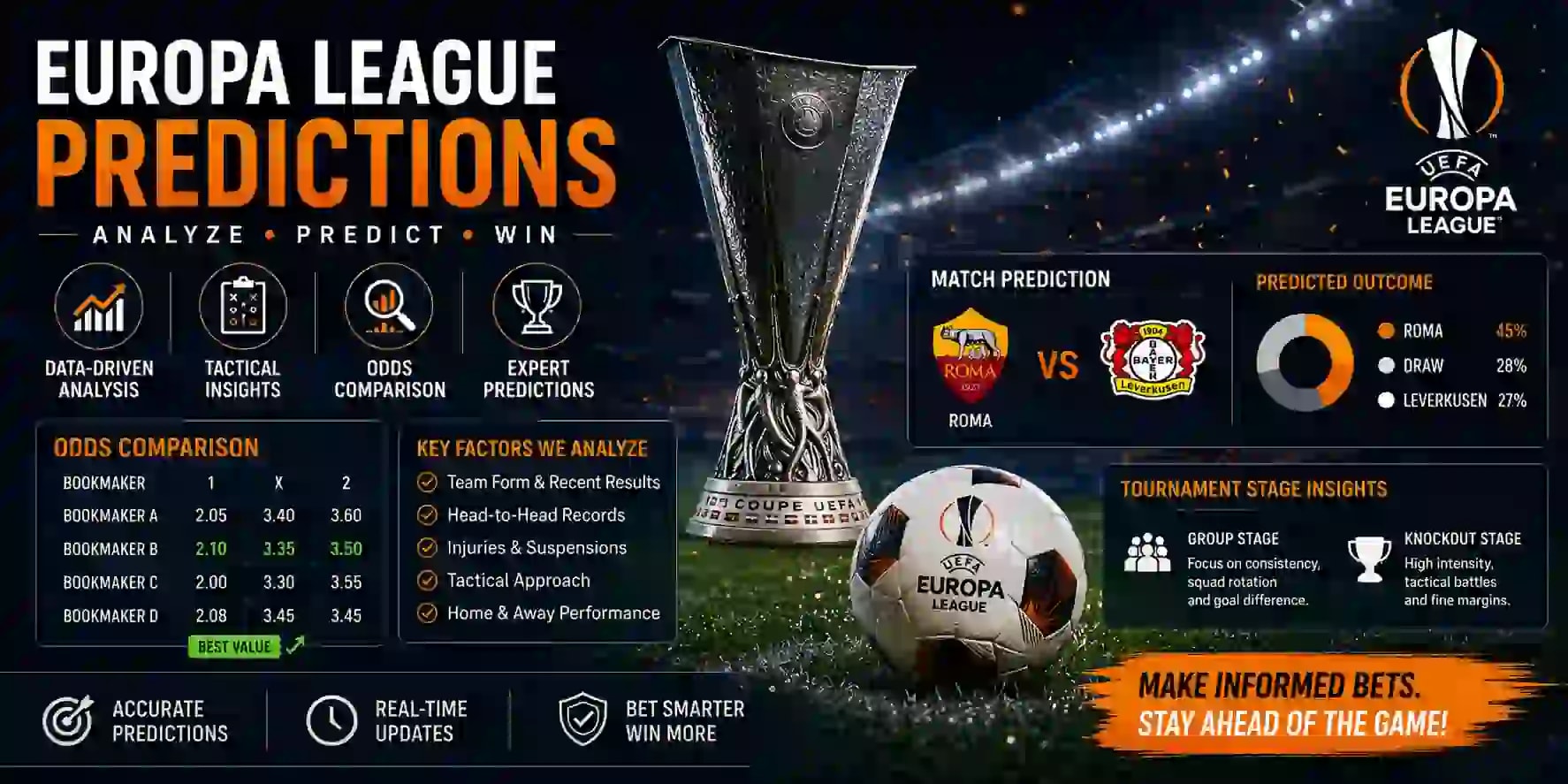
Europa League Prediction: Expert Betting Tips, Picks & Analysis
Europa League football sits in an unusual spot on the European calendar. It runs alongside the Champions League every midweek, often features clubs juggling three competitions at once, and produces a wider spread of playing styles than almost any other tournament in the sport. That mix is exactly why building a reliable Europa League prediction takes more than checking a league table. This guide breaks down how a serious Europa League prediction actually gets built, drawing on the same data-led approach used across our Champions League predictions and the wider Football Predictions hub. If you're tracking results as they land, our Europa League live scores page covers every matchday in real time.
Most people searching for Europa League predictions today want one of two things: a clear read on an upcoming fixture, or a framework they can apply themselves once team news and odds are confirmed. This article covers both. It sets out the analytical process form, fitness, tactics, fixture load and explains how that process should shift depending on whether a tie sits in the league phase or the knockout rounds.
Why Europa League Predictions Require a Different Lens
The Europa League pulls clubs from across nearly every UEFA member league, which means a much wider spread of squad quality, tactical identity, and competition priorities than the Champions League sees. A club parachuted in after Champions League group-phase elimination plays the competition very differently from a side that built its whole season around reaching a European final.
That variation matters for anyone building UEFA Europa League prediction models. A club's domestic standing doesn't translate cleanly into European form, and assuming it does is one of the more common mistakes in casual analysis. The same is true in reverse our La Liga predictions, Bundesliga predictions, and EPL predictions all track domestic form separately precisely because European and domestic form drift apart more often than people expect.
Three factors drive that gap. Squad rotation tends to be heavier in the Europa League than in the Champions League, since clubs competing on multiple fronts often treat it as the competition where squad depth gets tested first. Travel demands are also higher on average fixture lists frequently send clubs across longer distances to face less familiar opponents than a typical Champions League group would produce. And motivation varies more by stage: early fixtures sometimes get a weaker XI once qualification looks secure, while knockout legs pull out a club's strongest available side regardless of domestic priorities that week.
Today's Europa League Prediction Framework
Building an Europa League prediction for any given matchday means running the same checklist regardless of which two clubs are involved. The framework below is what separates an informed Europa League match prediction from a guess wrapped in football language.
Confirmed team news first. Lineups announced close to kickoff move a prediction more than anything published a day earlier. A rotated front line or a rested first-choice goalkeeper changes the entire risk profile of a match, and reacting to that late information is usually more valuable than any pre-match model.
Form read against opponent quality. A run of strong results means little without checking who they came against. Beating weaker domestic sides says nothing about how a team copes with a well-drilled European opponent playing a different system.
Underlying chance quality over recent scorelines. Goals scored and conceded are a lagging indicator. Shot quality, buildup patterns, and chances conceded tell you more about where a team is heading than last week's final score.
Fixture context and competition priority. A club fighting for a domestic title in the same week often fields a different Europa League side than one with nothing else to focus on. Reading the calendar around a fixture is part of reading the fixture itself.
Tactical fit between the two sides involved. General playing style only tells part of the story the more useful question is how a team's specific approach holds up against this particular opponent's setup.
Treat these as inputs that need to agree with each other, not a formula that spits out a single number. When several of them point the same direction, a prediction carries real weight. When they conflict, that's usually the signal to lower confidence rather than force a conclusion.
Understanding Europa League Match Analysis
A proper Europa League match prediction starts well before kickoff and continues to shift right up until teams are confirmed. The analysis process generally moves through a few distinct layers.
The first layer is structural: what does each club need from this specific match, given where they sit in their group or knockout tie. A side that's already qualified plays differently from one fighting to avoid an early exit, even if the two teams look evenly matched on paper.
The second layer is stylistic: how does each team actually set up. Possession share alone says little the more useful breakdown looks at where on the pitch a team builds attacks, how compact it stays without the ball, and how quickly it transitions once possession changes hands.
The third layer is situational: injuries, suspensions, recent travel, and rest days since the last fixture. These details rarely show up in season-long statistics but frequently decide individual matches.
Combining all three layers is what separates a researched Europa League score prediction from a number picked because it "feels right." None of the three layers is sufficient alone a tactically dominant team missing two first-choice defenders is a different proposition than the same team at full strength.
Team Form Evaluation
Form is the most commonly cited factor in football predictions and also the most commonly misread. A team's last five results only become useful once they're weighted against who those results came against, where the matches were played, and whether the squad used was close to full strength.
Useful form indicators worth tracking for accurate Europa League predictions include:
- Results adjusted for opponent strength, not just wins and losses
- Goals scored and conceded broken down by home and away venue
- Performance trend over the last six to eight matches rather than the last two or three
- Whether good or poor form has been built with a consistent starting XI or a heavily rotated one
- How a team has performed specifically in European fixtures versus domestic ones this season
A side can look strong domestically while struggling against the different tempo and physicality of European opposition, and the reverse happens just as often. Treating domestic and European form as related but separate datasets produces far more reliable Europa League match predictions than assuming one predicts the other.
Home vs Away Performance
Home advantage in European competition is not a fixed bonus applied evenly across every club. Some teams post genuinely different underlying numbers away from home not just worse results, but a measurably different approach, often sitting deeper and conceding territory it wouldn't concede domestically.
Several factors widen the home-away gap specifically in the Europa League:
- Longer average travel distances than most domestic fixtures, which can affect recovery time before and after matches
- Unfamiliar pitch dimensions, surface types, and even climate differences across countries
- Reduced crowd familiarity for visiting fans compared to closer, more frequent domestic away days
- Some clubs relying on home atmosphere and crowd intensity far more than others to lift performance levels
Tracking a club's away record specifically not its overall record is one of the more reliable ways to catch value that a general "team is in good form" narrative misses. A team that's excellent at home but consistently cautious or fragile away tells you something a combined record hides entirely.
Squad Rotation Impact
Clubs in the Europa League are almost never focused on a single competition. Most are balancing a domestic league campaign, a domestic cup run, and continental football simultaneously, which makes squad rotation one of the most decisive factors in week-to-week prediction accuracy.
Key questions worth asking before backing any Europa League pick:
- How deep is the squad at the positions that matter most for this specific matchup, particularly centre-back and central midfield
- Has the manager shown a pattern of heavy rotation in this competition compared to domestic fixtures
- Is this match sandwiched between two demanding domestic fixtures, increasing the likelihood of rest for key players
- Are any rotated players clear downgrades, or does the squad have genuine like-for-like cover
Clubs with strong squad depth tend to absorb rotation without much drop in performance level. Clubs leaning on a smaller core group of players are far more exposed when two or three regulars are rested or unavailable in the same week.
Fixture Congestion Analysis
Fixture congestion compounds quietly over a season rather than announcing itself in any single match. A club playing its third match in seven days carries accumulated fatigue that doesn't always show up in a pre-match form check but shows up clearly in second-half performance data.
December and the run into February tend to be the most congested period for clubs still competing across multiple fronts, and this is exactly when fixture-congestion analysis becomes most valuable for Europa League predictions. Tracking how many matches a side has played in the prior two to three weeks, how much travel was involved, and how many of those matches went to extra time all feed into a more complete picture than form alone provides.
This is also where squad value and rotation depth start to separate clubs that can sustain a deep European run from clubs that fade once the schedule compresses.
Tactical Matchups
Tactical fit between two specific opponents tends to matter more in the Europa League than broad reputation does. A high-pressing side facing a team comfortable building under pressure produces a very different match than the same high-pressing side facing a team that simply sits deep and absorbs.
Areas worth examining for any Europa League match prediction include how a team's pressing triggers match up against the opponent's build-up patterns, whether one side's preferred wide areas of attack line up against a defensive weakness on the other side, and how each team has historically performed against a similar tactical profile this season, not just against this specific opponent historically.
Two-legged knockout ties add another tactical layer entirely. A manager's approach to a first leg away from home often more conservative, prioritising a workable scoreline over a win frequently differs from how the same manager approaches a standalone league fixture. Reading a single leg without the context of the tie as a whole is one of the more common errors in knockout-stage analysis.
Injury and Suspension Analysis
A confirmed absence at a key position changes more than just who starts it changes the entire defensive or attacking structure a team can field that night. This matters more in the Europa League than people often assume, since squads competing across multiple fronts are more exposed to accumulated knocks and yellow-card suspensions building up across a long season.
When assessing injury and suspension news for an upcoming Europa League prediction, the position matters as much as the player. Losing a rotation squad striker rarely shifts a prediction much. Losing a first-choice goalkeeper, a starting centre-back pairing partner, or the player a team's pressing system is built around usually does.
Suspensions carry an added wrinkle in two-legged ties: a player picking up a card in the first leg that rules them out of the second leg is a detail easy to miss but significant enough to change how the second match should be read entirely.
Knockout Round Strategy
Knockout football in the Europa League rewards a different skill set than the earlier league or group-style stage. Managing a narrow lead through a tense closing period, or recovering from a first-leg deficit without abandoning defensive structure, are abilities that show up disproportionately among clubs and managers with prior knockout experience in European competition.
Patterns worth tracking heading into knockout rounds:
- How a club has historically performed in away first legs specifically, separate from its general away record
- Whether a manager tends to make conservative or aggressive substitutions when protecting a slim aggregate lead
- How a squad has handled extra time and penalty shootouts in the past, since composure under that specific pressure varies significantly between clubs
- Whether a team's most reliable attacking players have a track record of producing in high-stakes knockout moments specifically, rather than just across a full season
A club that performs reliably across the earlier rounds but has a habit of underperforming once knockout stakes rise is a genuine, trackable pattern not simply bad luck repeating itself.
Betting Market Interpretation
Reading Europa League odds well means separating genuine new information from market noise driven by reputation or public betting volume. Odds shift constantly, but not every shift reflects something meaningful about the match itself.
A few habits consistently improve how odds get read. Comparing pricing across multiple sportsbooks rather than anchoring to the first number seen tends to surface the clearest value, since discrepancies between books on the same fixture are often exactly where mispricing sits our Europa League odds coverage tracks this across markets in real time. Watching how a line moves in the final hours before kickoff, rather than days out, usually reflects genuine team-news information rather than general betting sentiment. And treating heavily favoured pricing on a famous club with some scepticism is worthwhile, since markets can overvalue reputation while underpricing a less prominent but tactically disciplined opponent.
Markets beyond the straight match result frequently hold more value than the headline win/draw/loss price. Total goals markets tend to work well when a strong defensive side faces an inconsistent attack. Both teams to score often reflects defensive solidity more precisely than the match-result market alone. Player-specific props move less aggressively with public sentiment simply because fewer bettors track them closely, and two-leg aggregate markets require weighing game-state context that a single-match price ignores entirely.
Europa League Betting Tips Worth Following
Sound Europa League betting tips come from process discipline more than any single insight. A few principles apply regardless of which fixture is in front of you.
- Treat late team news as the final filter before locking in any pick a confirmed lineup overrides almost any pre-match assumption
- Size stakes consistently rather than increasing bet size to chase a previous loss
- Look past the obvious match-result market when a team's underlying numbers suggest value sits elsewhere, such as in goals totals or both-teams-to-score
- Read every leg of a knockout tie in the context of the tie as a whole, not as an isolated standalone match
- Treat any single Europa League pick as one data point across a longer run of fixtures, not a result that needs to be won outright
The same discipline applies across every competition we cover, from the FA Cup to the Champions League markets differ, but the process of separating signal from noise stays consistent.
Europa League Winner Prediction Factors
Predicting an eventual Europa League winner is a season-long exercise, not a single-match call. It requires weighing squad depth across a full campaign rather than just the eleven players likely to start any individual fixture.
A handful of traits separate genuine contenders from clubs that fade once the rounds get tougher. Depth across key positions matters most clubs able to rotate at centre-back, central midfield, and in attack without a significant drop in quality tend to hold up better across a season juggling European, domestic league, and domestic cup commitments at once. Prior knockout experience matters almost as much, since managing tight aggregate scores and high-pressure moments are skills that show up more reliably among clubs that have already been through deep continental runs. And consistency across formats performing well in the earlier rounds, then holding that level once the competition tightens into knockout football is the clearest long-run signal available for any genuine Europa League winner prediction.
No early-season winner prediction should be treated as fixed. Squad business, managerial changes, and injuries reshape genuine contenders constantly, which is exactly why a prediction made months out should be read as a loose shortlist rather than a locked-in call.
Europa League Score Prediction: Where xG Fits In
Expected goals (xG) has become one of the more dependable tools for building an Europa League score prediction, mainly because it measures the quality of chances created rather than just the raw number of goals scored. A side consistently outperforming its underlying xG numbers is often due some regression toward the mean, while a side underperforming its numbers may have a sound process that simply hasn't been reflected in results yet.
xG isn't a complete answer on its own. It doesn't account for an outstanding individual goalkeeping performance, a red card altering a match's complexion, or a team deliberately accepting fewer chances by sitting deep as a deliberate tactical choice. The most reliable score predictions combine xG trends with confirmed lineups, fixture context, and in knockout ties the state of the overall aggregate score, rather than leaning on any single model as a final answer.
A Note on Responsible Betting
Europa League predictions, score models, and odds analysis are tools for making better-informed decisions, not guarantees of a winning outcome. Football remains genuinely unpredictable, and even well-researched predictions miss regularly because that's the nature of the sport rather than a flaw in the process. Anyone betting on Europa League matches should only stake what they're comfortable losing and treat betting as entertainment rather than a source of reliable income.
For broader coverage across competitions, our Football Predictions hub also covers the Champions League, Serie A, Nations League, and FIFA World Cup the same principles of context, current form, and disciplined market reading apply throughout each one.
About the Analysis
Author: EZTips Football Analysis Team
Expertise:
- Football prediction research across major European and international competitions
- European football analysis spanning league-phase, group, and knockout formats
- Sports betting insights, including odds-market behaviour and value identification
- Data-driven match evaluation built on expected goals (xG), squad rotation patterns, and fixture-congestion analysis
This guide is reviewed and updated as the Europa League calendar progresses, reflecting confirmed fixtures, squad news, and format details rather than speculative match outcomes.
Last Updated: 17 June 2026
Frequently Asked Questions