How Much Is One Unit in Betting
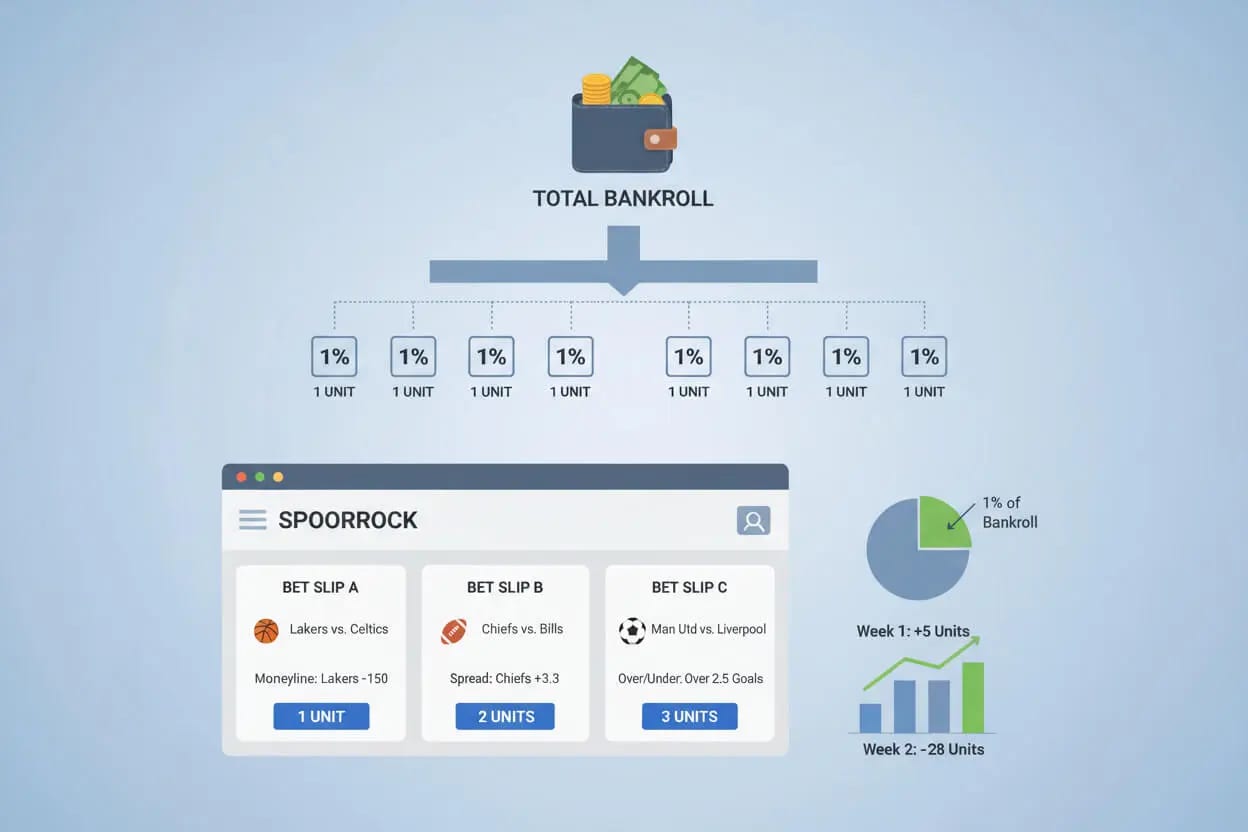

If you have spent any time reading betting guides, scrolling through picks on social media, or watching betting analysis videos, you have seen the phrase “one unit” repeatedly. Sometimes it is framed as a one-unit play. Sometimes it is two units or even five units. Despite how often the term appears, most bettors never receive a clear explanation of what a unit actually represents. That lack of clarity creates inconsistent bet sizing, emotional decisions, and long-term losses that often feel confusing or unfair.
Understanding how much one unit is in betting is not a small detail. It is one of the most important structural concepts in wagering. Units are not about prediction quality or market knowledge. They are about survival, consistency, and discipline. A bettor who understands units but makes average picks will often outperform a bettor with sharper analysis but reckless sizing.
This guide breaks the concept down fully. It explains what a unit is, how it is calculated, why professionals rely on it, how it protects bankrolls during losing streaks, and how misuse quietly damages betting results over time.
What a Unit Means in Sports Betting
A unit in betting is a measurement of risk, not a fixed amount of money. This distinction matters more than most bettors realize. A unit does not represent a specific dollar value across all bettors. Instead, it represents a consistent portion of a bettor’s total bankroll.
When someone says they placed a one-unit bet, they are not saying how much money they wagered. They are saying how much of their bankroll they risked. Two bettors can both place one-unit bets while risking completely different dollar amounts. As long as the percentage of bankroll is the same, the unit definition remains correct.
This is why units exist. They standardize risk, not spending. They allow bettors to scale their wagering activity without changing behavior or emotional exposure.
The Standard Definition Used by Most Bettors
Across long-term bankroll management models and professional betting frameworks, one unit is most commonly defined as one percent of total bankroll. This approach appears repeatedly because it balances growth potential with drawdown control.
When one unit equals one percent, the math stays simple and predictable. A bankroll of one hundred dollars results in a one-dollar unit. A bankroll of one thousand dollars results in a ten-dollar unit. A bankroll of ten thousand dollars results in a one-hundred-dollar unit. The dollar value changes, but the risk profile remains identical.
This percentage-based structure prevents bettors from accidentally increasing risk as bankrolls grow or shrinking exposure so much that progress becomes impossible. The system adjusts automatically.
Why Units Exist Instead of Fixed Bet Sizes
Many bettors start by wagering flat dollar amounts. They might bet twenty dollars on every game or increase wagers when they feel confident. This approach feels intuitive but creates several problems.
First, fixed dollar bets lose context as bankrolls change. Twenty dollars represents twenty percent of a one-hundred-dollar bankroll but only two percent of a one-thousand-dollar bankroll. The same bet carries wildly different risk levels.
Second, fixed betting encourages emotional scaling. Bettors tend to wager more after losses and less after wins, even when they do not realize it. This behavior increases volatility and accelerates losses.
Units remove these issues by anchoring every bet to a consistent level of risk. The focus shifts from chasing outcomes to managing exposure.
Understanding Bankroll Before Calculating Units
A unit only has meaning if the bankroll is defined honestly. A bankroll is not simply the balance sitting in a sportsbook account if that balance can be topped up impulsively. A bankroll is a fixed pool of money allocated specifically for betting, with the understanding that it could be lost entirely.
If losing the bankroll would affect rent, savings, or daily expenses, then the bankroll was never defined correctly. Units rely on discipline at this stage. Without it, even the best unit system fails.
Once the bankroll is defined, the unit calculation becomes straightforward. Choose a percentage, usually one percent, and calculate the corresponding dollar amount. That number becomes the standard risk for a one-unit bet.
How Professionals Decide Their Unit Size
Professional bettors do not choose unit sizes randomly. They rely on probability modeling, drawdown analysis, and historical variance. Most professionals operate within a narrow range between half a percent and one and a half percent per unit.
This range exists because losing streaks are inevitable. Even bettors with strong long-term edges experience extended periods of negative variance. A unit size must be small enough to absorb these streaks without forcing behavioral changes.
A bettor using a one-percent unit can lose ten bets in a row and still have ninety percent of the bankroll intact. A bettor using five percent per unit cannot survive the same streak. The difference is not prediction skill. It is risk management.
Flat Betting and Why It Works
Flat betting means wagering the same unit size on every standard bet. One unit remains one unit regardless of confidence, recent results, or emotional state. This approach is widely used because it minimizes decision fatigue and emotional interference.
Flat betting ensures that no single result carries disproportionate weight. It also simplifies record-keeping. Performance can be tracked accurately over time without adjusting for inconsistent risk levels.
While some bettors occasionally increase to two units for higher-confidence plays, disciplined bettors reserve this sparingly. Anything above three units is rare and often avoided entirely.
What Higher Unit Bets Actually Represent
A two-unit or three-unit bet does not mean a guaranteed outcome. It simply reflects higher relative confidence compared to other wagers. The distinction is important. Units measure confidence, not certainty.
A one-unit bet represents a standard edge. A two-unit bet represents a stronger edge. A three-unit bet represents a rare situation where multiple factors align. When bettors routinely place large-unit bets, it signals poor discipline rather than confidence.
Consistent overuse of high-unit plays dramatically increases volatility and undermines the purpose of the unit system.
Units and Odds Explained Together
Units measure risk, not potential winnings. This is a common source of confusion. A one-unit bet at negative odds risks one unit to win less than one unit. A one-unit bet at positive odds risks one unit to win more than one unit.
For example, a one-unit wager at minus one-ten odds risks one unit to win approximately zero point nine one units. A one-unit wager at plus one-fifty risks one unit to win one point five units. The unit remains constant. The return changes.
This approach ensures that performance tracking remains accurate across different odds ranges. Wins and losses are measured consistently, regardless of payout structure.
Why Chasing Losses Breaks the Unit System
Chasing losses often begins when bettors abandon unit discipline. After a loss, the temptation to increase the next bet to recover quickly becomes strong. This behavior compounds risk and accelerates drawdowns.
The unit system exists specifically to prevent this escalation. By fixing risk per bet, losses remain proportional and manageable. Once units are ignored, emotional decision-making replaces structure.
Most bankroll collapses occur not from bad picks, but from abandoning unit sizing after losses.
How Units Protect Against Losing Streaks
Losing streaks are unavoidable in betting. A bettor winning fifty-five percent of wagers will still experience multiple losing streaks each season. These streaks do not indicate poor skill. They are a normal part of probability.
Units limit the damage during these periods. At one percent per unit, even a severe losing streak results in a drawdown that can be recovered over time. Without units, the same streak often leads to bankroll depletion.
This protective effect is the single most important advantage of using units.
Psychological Benefits of Betting in Units
Units reduce emotional pressure. When bets are framed as percentages rather than dollars, outcomes feel less personal. Losses become expected statistical events rather than failures. Wins become part of a long-term process rather than moments to celebrate excessively.
This psychological stability helps bettors maintain discipline across hundreds or thousands of wagers. It also prevents impulsive adjustments driven by short-term results.
When Unit Size Should Be Adjusted
Units should only be adjusted after significant bankroll changes. Many disciplined bettors recalibrate units after a twenty to thirty percent increase or decrease in bankroll. This ensures that risk remains proportional over time.
Adjustments should never be made mid-session or in response to emotional swings. Unit recalculation is a scheduled process, not a reactive one.
Units Versus Bet-to-Win Amounts
Some bettors prefer betting fixed amounts to win a specific dollar figure. This method introduces inconsistent risk exposure. Different odds require different risk levels to achieve the same payout.
Units eliminate this inconsistency by focusing on risk first. Returns vary naturally based on odds, but exposure remains stable.
Misleading Use of Units in Public Betting Content
Units can be misused as marketing language. Claims of large unit profits mean little without transparency. Timeframe, bet volume, average odds, and unit definition all matter.
Without context, unit claims are just numbers. A sound betting system focuses on process, not promotional results.
Common Unit Mistakes Bettors Make
Many bettors change unit size frequently, often without realizing it. Others define units without defining bankrolls. Some overuse high-unit plays. Others ignore variance entirely.
Each mistake undermines the protective purpose of units. Correct unit usage requires consistency above all else.
A Simple Rule for Choosing the Right Unit Size
There is one practical rule that captures proper unit sizing perfectly. If losing five bets in a row changes how you feel or how you bet, your unit size is too large. Proper units allow bettors to continue operating rationally through normal variance.
Final Thoughts on One Unit in Betting
So how much is one unit in betting? It is a fixed percentage of bankroll, most commonly one percent. It is a risk management tool designed to standardize exposure, control variance, and remove emotion from decision-making.
Units are not exciting. They are not shortcuts. They are structure. Bettors who respect units stay in the game long enough for edges to matter. Bettors who ignore them often learn expensive lessons.
In betting, discipline is not optional. It is the foundation.
Frequently Asked Questions
More blogs

Wagering Meaning: What Does Wagering Mean in Betting and Gambling?
23 Sept 2025

Unpacking the Odds: What 'Over 2.5 Goals' Means for Your Football Bets
03 Oct 2025

Mastering the Under 2.5 Goals Betting Strategy
06 Oct 2025

Understanding the "Both Teams to Score" (BTTS) Market: A Comprehensive Guide
08 Oct 2025
Sports Betting Blogs
Mastering the Under 2.5 Goals Betting Strategy
. 06 Oct 2025