
FIFA Rankings Explained: Betting & Predictions Guide 2026
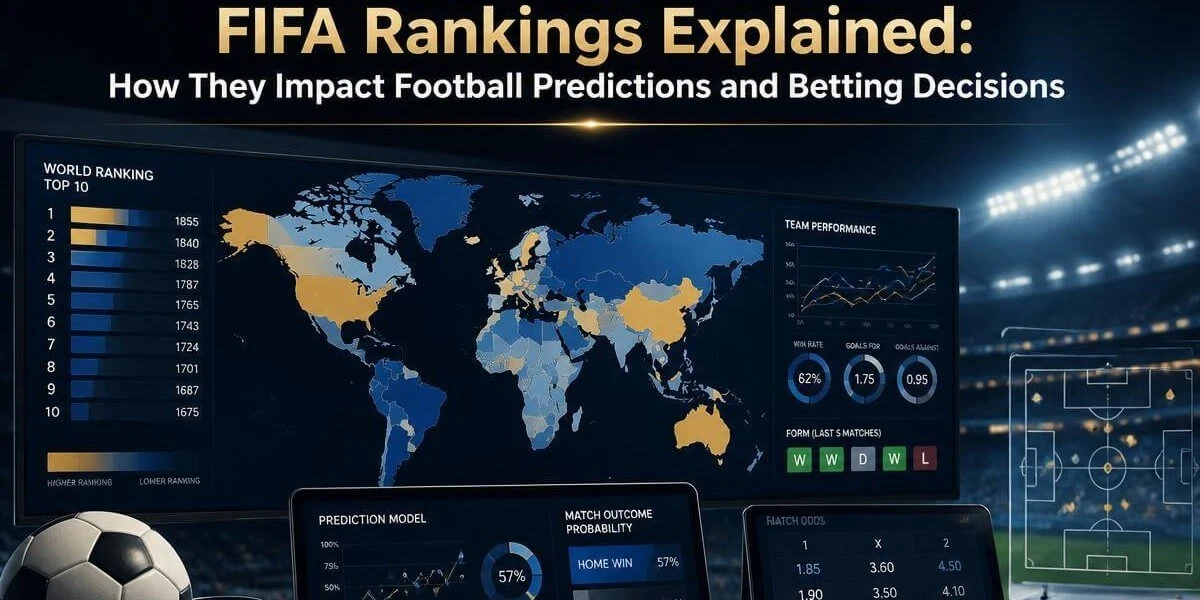

FIFA Rankings Explained: How They Impact Football Predictions and Betting Decisions
Football fans often assume that if one team is ranked significantly higher than another, the result is almost predetermined. Bettors make the same mistake every day. They see Argentina ranked above another nation or France sitting near the top of the FIFA world rankings football table and immediately conclude that betting on the favorite is the safest option. While rankings are certainly useful, they are only one piece of a much larger puzzle.
Understanding how FIFA rankings work allows bettors to separate genuine statistical advantages from public perception. Rankings measure long-term performance, but football matches are decided by current form, tactics, injuries, motivation, and dozens of variables that change from game to game. A team that deserves to be ranked fifth in the world can still struggle against a disciplined opponent ranked thirtieth if the circumstances are different.
For anyone interested in football predictions FIFA ranking analysis, the objective should not be to blindly follow the rankings but to understand what they actually represent. Throughout this guide, you'll learn how FIFA calculates team strength, why bookmakers pay attention to rankings, where rankings succeed, where they fail, and how they can become a valuable tool for making better betting decisions ahead of the World Cup 2026 and other major international tournaments.
What Are FIFA World Rankings in Football?
The FIFA world rankings football system is an official method used to compare the relative strength of men's national football teams across the globe. Rather than relying on opinions, historical reputation, or the number of famous players in a squad, FIFA assigns numerical ratings based on match results and updates those ratings after international fixtures.
The purpose is straightforward: create a standardized system that reflects how national teams perform over time. This helps organize tournament seedings, provides a reference for fans and analysts, and offers a benchmark for comparing teams that rarely play against one another.
However, many people misunderstand what these rankings actually measure. They do not attempt to predict the next match. Instead, they summarize how teams have performed over an extended period under FIFA's ranking methodology.
For bettors, this distinction is extremely important. Rankings describe historical performance, while betting markets attempt to estimate future probability. Those two concepts often overlap, but they are never identical.
Why Did FIFA Create Rankings?
Before rankings existed, discussions about the world's best national team were largely subjective. One analyst might argue that the reigning World Cup champion deserved the top position, while another would prioritize recent friendly results or continental championships.
As international football expanded, FIFA needed a more objective framework to compare teams from different continents. A ranking system provided consistency and made tournament organization more transparent.
Today, rankings influence several aspects of international football, including:
- Tournament seeding
- Media analysis
- Public perception
- Statistical comparisons
- Betting discussions
One of the most important practical uses of FIFA rankings is tournament seeding. Rankings help determine how teams are distributed into pots before many international competitions, reducing the likelihood that several of the strongest teams are grouped together early. As a result, rankings can indirectly influence a team's tournament path long before a ball is kicked, making them relevant not only for analysts and bettors but also for competition structure itself.
Although rankings are not the sole factor used for tournament draws, they remain one of the most recognized indicators of national team strength.
Expert Note
A common misconception is that FIFA rankings exist primarily for bettors. They do not. Their original purpose was administrative and competitive, helping compare national teams across competitions. Bettors later adopted them as an analytical tool because they provide an easily accessible measure of long-term performance.
FIFA Rankings vs Club Football Success
One of the biggest mistakes beginners make is confusing club football with international football.
Manchester City may dominate the Premier League. Real Madrid may win the UEFA Champions League. Bayern Munich may control the Bundesliga. None of those achievements directly improve England's, Spain's, or Germany's FIFA ranking.
Club football and international football operate under completely different conditions.
Club managers train with their squads almost every day throughout the season. National team coaches often have only a few days before an international fixture to prepare tactical plans and integrate players arriving from different leagues around the world.
Similarly, a country can produce outstanding clubs while its national team struggles to convert talent into results. The reverse is also true. Some national teams consistently outperform expectations despite having relatively few global superstars.
For betting purposes, this distinction matters because many casual bettors unconsciously transfer club form into international expectations. Seeing a striker score thirty league goals does not automatically mean his national team will dominate its next qualifier.
Practical Scenario
Imagine two bettors preparing for a World Cup qualifier.
Bettor A notices that several players from Team X play for elite European clubs and immediately backs them to win.
Bettor B starts differently. He checks:
- FIFA ranking
- Recent international form
- Injuries
- Tactical matchup
- Travel schedule
- Motivation
Even if both bettors ultimately choose the same team, Bettor B has built a decision based on evidence rather than reputation.
Over hundreds of bets, this disciplined approach generally produces better decision-making.
How FIFA Rankings Have Changed Over Time
The FIFA ranking system introduced in 1992 has not remained unchanged. Since their introduction in 1992, the rankings have undergone several revisions to improve accuracy, with the current SUM methodology being adopted in 2018. These changes were intended to reduce distortions seen in earlier systems and better reflect actual team performance over time.
Earlier versions received criticism because teams could manipulate rankings by avoiding certain friendlies or because the calculations sometimes rewarded inactivity more than performance. Critics argued that some teams could protect or improve their ranking by carefully selecting opponents or limiting participation in lower-value matches. The revised SUM methodology was introduced to reduce these strategic distortions and ensure that rankings better reflected competitive performance rather than scheduling decisions.
To address these concerns, FIFA introduced a new methodology in 2018 known as the SUM system, which follows principles similar to Elo rating models used in other sports and competitive games.
Instead of recalculating rankings through averaging formulas, teams now gain or lose points after matches based on expectations and outcomes. This creates a system that reacts more naturally to actual performance.
For example:
- Defeating a stronger opponent generally results in a larger point increase.
- Losing to a much weaker team causes a larger penalty.
- Expected results produce relatively smaller changes.
This makes rankings more dynamic and better aligned with competitive reality.
Fact Box
Important facts about FIFA rankings
- They apply only to national teams.
- They are updated after official international match windows.
- The current SUM methodology was adopted in 2018.
- Competitive matches carry greater significance than friendlies.
- Teams gain or lose points rather than simply accumulating victories.
These facts explain why rankings should be interpreted as an evolving performance measurement rather than a simple league table.
Why Bettors Care About FIFA Rankings
If rankings cannot predict individual matches perfectly, why do bettors pay so much attention to them?
They provide context. Suppose you know absolutely nothing about two national teams preparing to play each other. Learning that one team is ranked 8th while the other is ranked 72nd immediately gives you a baseline expectation about relative quality.
That information alone should never determine a bet, but it creates a starting point for deeper analysis.
Professional analysts often build their evaluation in layers:
- Overall team strength
- Recent form
- Squad availability
- Tactical matchup
- Venue and travel
- Market odds
Notice that rankings appear near the beginning, not the end. They help establish a foundation before more specific factors are examined.
This is why FIFA rankings and betting are closely connected. Rankings influence public opinion, which influences betting markets, which in turn influences value opportunities.
However, value is rarely created by agreeing with everyone else. It is often created by identifying situations where rankings and reality are temporarily out of sync.
Key Takeaway
Think of FIFA rankings as the opening chapter of a book rather than the entire story.
They tell you where a team has been.
They do not tell you everything about where that team is today or where it will be tomorrow.
The smartest bettors use rankings to ask better questions, not to make automatic predictions.
Professional analysts rarely treat FIFA rankings as a prediction model. Instead, they use rankings as an initial benchmark before testing whether current form, tactical matchups, injuries, and betting prices support or contradict that benchmark.
How FIFA Rankings Work
Many football fans know that FIFA publishes rankings after international windows, but very few understand how FIFA rankings work behind the scenes. This lack of understanding often leads to poor predictions and misguided betting decisions. People assume that rankings are based simply on the number of matches won or trophies collected, when in reality the calculation is far more sophisticated.
The current FIFA ranking system aims to answer one question: How strong is a national team relative to every other national team based on its recent competitive performances? Instead of resetting rankings every season, FIFA continuously adjusts each team's rating after official international matches. Every result either strengthens or weakens that team's position.
Think of the rankings as a constantly moving stock market rather than a league table. When a company performs well, investor confidence rises. When results disappoint, confidence falls. FIFA rankings operate in a similar way, with every international fixture affecting the perceived strength of a national team.
This approach makes the rankings more dynamic than older systems. A single victory will not suddenly make a mid-ranked nation the best team in the world, but consistent performances against quality opposition gradually build a stronger rating. Likewise, repeated disappointing results slowly reduce a team's standing regardless of its historical reputation.
For bettors, this is valuable because rankings represent long-term consistency, while individual matches represent short-term uncertainty. This distinction explains why analysts often separate "team strength" from "current form." A nation may remain highly ranked because of several years of excellent performances while simultaneously entering a tournament with poor recent results. Successful predictions require evaluating both dimensions rather than relying on only one.
How FIFA Calculates Team Points
One of the most searched questions is "how FIFA calculates team points." The answer is simpler than many people think, although the mathematics behind the system can become technical.
Rather than awarding fixed points for every victory, FIFA considers multiple variables before adjusting a team's rating. Winning a World Cup knockout match against a top-ranked nation should obviously count for more than defeating a lower-ranked team in a friendly, and the ranking system attempts to reflect that reality. The underlying logic is based on expected performance. When a strong team defeats a much weaker opponent, the result largely matches expectations and therefore produces only a limited rating gain. However, when an underdog defeats a highly ranked team, the outcome provides new information about relative team strength, causing a much larger adjustment. The ranking system therefore rewards unexpected results more heavily than predictable ones.
Instead of focusing on complicated formulas, bettors should understand the principles that drive ranking changes.
Factor 1: Match Result
The most obvious factor is the final outcome.
Winning improves a team's rating.
Drawing usually produces a smaller adjustment depending on expectations.
Losing generally results in lost points.
However, the result itself is only part of the calculation. The importance of that result depends heavily on who the opponent was and what competition was being played.
For example, defeating Brazil in a World Cup knockout match carries much greater significance than defeating a lower-ranked nation in a friendly tournament.
Factor 2: Strength of the Opponent
Not every victory has equal value.
Imagine these two scenarios:
Scenario A
England defeats a team ranked 120th.
Scenario B
England defeats Argentina.
Although both matches end with a victory, the second result demonstrates a much higher level of performance because the opponent is significantly stronger.
Likewise, losing to a top-ranked team may have a relatively modest effect compared with losing to a much weaker nation.
This prevents rankings from rewarding easy schedules while encouraging competitive performance against stronger opposition.
Factor 3: Importance of the Match
This is one of the biggest reasons rankings should never be interpreted too simply.
International matches differ enormously in importance.
A friendly often serves as an opportunity to test younger players, experiment tactically, or build fitness.
A World Cup knockout match, however, determines whether a nation remains in the tournament.
Because the stakes are dramatically different, FIFA assigns greater importance to major competitions.
That means:
- World Cup matches matter more.
- Continental championships matter more.
- Qualifiers generally matter more than friendlies.
As a result, one outstanding tournament can significantly improve a team's ranking, while poor performances on the biggest stage can have lasting consequences.
Factor 4: Previous Rating
Every team enters a match with an existing rating.
This existing rating forms the baseline from which gains and losses are calculated.
Suppose Team A has built years of excellent performances and currently sits among the world's elite. One unexpected defeat will certainly reduce its rating, but it will not immediately erase years of consistency.
Similarly, an emerging nation cannot jump from outside the top 100 to the top 10 after one impressive victory.
The system rewards sustained excellence rather than isolated moments.
This slow movement is intentional rather than a weakness. If rankings reacted dramatically after every upset, they would become unstable and lose their value as long-term performance indicators. By adjusting gradually, the system reduces the influence of short-term randomness while rewarding consistency across many matches.
Expert Note
Many casual bettors assume rankings should react dramatically after a major upset.
In reality, stability is one of the strengths of the FIFA ranking system.
If rankings changed completely after every surprising result, they would become unreliable indicators of long-term team quality.
Instead, FIFA attempts to balance recent performance with historical consistency, producing rankings that evolve gradually rather than emotionally.
Why Rankings Sometimes Surprise Fans
Every time new rankings are released, debates begin.
Supporters ask questions such as:
- Why is Team X still ranked above Team Y?
- How did this team move up despite losing recently?
- Why hasn't a tournament winner climbed higher?
Most of these questions arise because people focus on one recent match rather than the broader performance record.
Consider a student who scores 95% in every exam throughout the year but then receives 75% on the final test. Their overall average remains excellent because one result does not erase months of strong performance.
FIFA rankings work similarly.
The system values sustained competitiveness across many matches rather than reacting dramatically to isolated outcomes.
Practical Example
Imagine two hypothetical teams entering World Cup 2026.
Team Alpha
- Ranked 4th
- Consistent results over three years
- Strong performances against elite opponents
- Reached multiple tournament semifinals
Team Beta
- Ranked 27th
- Excellent last three matches
- Won several friendlies convincingly
- Limited success against top opposition
Many fans might focus on Team Beta's recent momentum.
However, FIFA rankings recognize that Team Alpha has demonstrated quality over a much longer period against stronger competition.
That does not guarantee Team Alpha will win their next meeting, but it explains why rankings continue to favor them.
Why FIFA Rankings Matter for Football Predictions
Football prediction models require a starting point.
Analysts need some way of estimating the relative strength of two teams before considering tactical factors, injuries, or betting markets.
This is where FIFA rankings become useful.
Rather than starting with emotion or reputation, analysts begin with objective historical performance.
If Team A is ranked 6th and Team B is ranked 58th, it is reasonable to assume that Team A has generally been the stronger side over recent years.
That assumption creates a baseline prediction.
The mistake occurs when bettors stop their analysis there.
Professional prediction models continue by evaluating:
- Recent form
- Squad selection
- Injuries
- Tactical systems
- Travel schedule
- Home advantage
- Motivation
- Betting market movement
Only after combining these variables can a realistic prediction be formed.
Practical Scenario
Imagine a World Cup group-stage match.
Team A
- FIFA Rank: 3
- Two starting defenders injured
- Already qualified
- Likely to rotate players
Team B
- FIFA Rank: 24
- Full-strength squad
- Must win to qualify
- Excellent recent form
Someone relying only on rankings immediately backs Team A.
Someone analyzing the complete situation recognizes that motivation and team selection may significantly reduce Team A's advantage.
The second bettor has built a stronger prediction process.
Does a Higher FIFA Ranking Mean a Better Chance of Winning?
In general, yes—but rankings increase probability rather than guarantee results.
Over hundreds of matches, higher-ranked teams generally win more often than lower-ranked teams. However, this relationship should not be interpreted as direct causation. FIFA rankings do not cause teams to win; rather, both rankings and victories are consequences of underlying factors such as player quality, tactical organization, coaching, and long-term performance. Rankings therefore function as indicators rather than causes of success. If that were not true, the ranking system would have little value.
However, football is one of the world's lowest-scoring major sports. Because goals are relatively rare, individual moments often determine outcomes.
One penalty.
One red card.
One goalkeeper mistake.
One deflected shot.
Any of these can change an entire match.
This makes football naturally more unpredictable than many high-scoring sports. Because relatively few goals are scored in most football matches, a single mistake, deflection, penalty, or red card can dramatically influence the final result. In higher-scoring sports, superior teams have more opportunities to demonstrate their quality, whereas football's low-scoring nature gives underdogs a greater chance of producing unexpected outcomes.
Therefore, rankings should be viewed as indicators of probability rather than guarantees.
Real-World Example
One of the greatest examples came during the 2022 FIFA World Cup, when Saudi Arabia defeated Argentina.
Argentina entered the tournament among the strongest teams in the world and eventually won the competition. Yet they still lost that group-stage match.
Did FIFA rankings fail?
Not necessarily.
Rankings suggested Argentina would usually outperform Saudi Arabia over many matches. They did not claim Argentina would win every single game.
This distinction is critical for bettors.
Probability is not certainty. This distinction highlights an important analytical principle: a prediction identifies the most likely outcome, while probability measures how often that outcome should occur over many similar matches. A team with a 70% estimated chance of winning is still expected to lose approximately three times out of every ten comparable situations.
Understanding that difference is one of the foundations of successful sports betting.
Key Takeaway
The best use of FIFA rankings is as the first layer of analysis, not the final decision.
They tell you who has consistently performed well over time.
They do not account for every injury, tactical adjustment, motivational factor, or market movement that exists before kickoff.
Smart bettors use rankings to ask better questions.
Casual bettors use rankings to make immediate conclusions.
Over the long run, those are two very different approaches.
FIFA Rankings and Betting: What Smart Bettors Actually Do
Many beginner bettors believe they have found an edge when they discover the FIFA rankings. They open the rankings page, compare two teams, notice that one is ranked much higher than the other, and assume they have identified the likely winner. Unfortunately, thousands of bettors are making the exact same assumption every day.
Professional bettors approach the situation very differently. They certainly acknowledge FIFA rankings, but they rarely allow rankings to make the decision for them. Instead, rankings become one variable inside a much larger analytical framework.
Think of building a football prediction like building a house. FIFA rankings provide the foundation, but a foundation alone is not enough. You still need walls, a roof, and structural support before the house is complete. Similarly, bettors need recent form, injuries, tactical analysis, motivation, and market pricing before they can confidently place a wager.
The biggest mistake casual bettors make is assuming that rankings predict matches. Professional bettors understand that rankings estimate long-term strength, while betting is about estimating the probability of a specific event occurring today.
Why Using FIFA Rankings Alone Can Be Dangerous
Suppose Team A is ranked 4th in the world, while Team B is ranked 32nd.
Without looking any further, many people immediately back Team A.
But let's add more information.
- Team A played 120 minutes four days ago.
- Two starting defenders are injured.
- The manager confirms several players will be rested.
- Team A has already qualified for the next round.
Now consider Team B.
- Full-strength squad.
- Eight matches unbeaten.
- Must win to qualify.
- Tactical style matches up well against possession-heavy opponents.
Has the ranking changed?
No.
Has the betting situation changed?
Absolutely.
This example illustrates why FIFA rankings should never be viewed in isolation. The rankings remain useful, but their significance changes once additional context becomes available.
A smart bettor constantly asks, "What information is the ranking not telling me?"
Expert Insight
The betting market already knows the FIFA rankings.
Bookmakers employ analysts, statisticians, and sophisticated pricing models. They are fully aware that one team is ranked higher than another. Simply identifying the ranking difference does not create betting value.
Value exists when the market has underestimated or overestimated the importance of that ranking gap.
An interesting industry mechanic is that sportsbooks must manage both probability and customer behavior. Casual bettors naturally prefer famous and highly ranked teams, which means bookmakers may shorten the odds on those teams because they expect heavy public support. As a result, the strongest team is not always the best betting value. Professional bettors therefore spend less time identifying who is likely to win and more time identifying whether public perception has pushed the price away from true probability.
The Six Factors Smart Bettors Combine With FIFA Rankings
Instead of relying on one statistic, experienced bettors build a layered analysis.
1. Recent Form
Rankings measure performance over time.
Recent form measures performance today.
Imagine a team that climbed into the world's top ten after three excellent years but has now won only one of its last six matches.
Its ranking may still look impressive, but its current level may be considerably lower.
Conversely, an emerging nation may still sit outside the top twenty despite showing outstanding performances over recent months because rankings adjust gradually rather than instantly.
This is why recent form should always accompany ranking analysis.
2. Injuries and Squad Availability
Football is ultimately played by players, not rankings.
If a national team loses:
- its leading goalscorer,
- its captain,
- its first-choice goalkeeper,
its ranking does not immediately reflect those absences.
Yet bookmakers and professional bettors understand their importance.
During major tournaments, one injury can completely change tactical balance.
For example, a creative midfielder may be responsible for set pieces, chance creation, and controlling possession. Losing that player reduces attacking quality even though the team's
FIFA ranking remains unchanged.
Therefore, checking squad news before betting should become routine.
3. Tactical Matchups
Football is rarely a simple contest between better and worse teams.
Sometimes it is a contest between styles.
A possession-oriented side may dominate weaker opponents but struggle against disciplined defensive teams that counterattack quickly.
Likewise, an aggressive pressing team may force mistakes from technically superior opponents.
This explains why certain lower-ranked nations consistently cause problems for stronger teams despite obvious differences in overall quality.
Rankings tell us who has generally performed better.
Tactical analysis tells us who may perform better today.
4. Motivation
Motivation cannot be measured by a ranking system.
Imagine two World Cup group matches.
Scenario One
A team already qualified for the Round of 32.
The coach decides to rotate six players.
The team only needs a draw.
Scenario Two
Their opponent must win to avoid elimination.
Every player knows defeat means going home.
The intensity between these two teams will almost certainly differ.
5. Travel and Playing Conditions
International football often involves significant travel.
Some teams cross continents, adjust to different climates, and play at unfamiliar stadiums within a short period.
Even elite teams can be affected by:
- travel fatigue,
- weather,
- altitude,
- humidity,
- pitch conditions.
These variables rarely appear in FIFA rankings but frequently influence performance.
For World Cup 2026, where matches will take place across multiple countries and cities, travel management could become even more significant than many bettors expect.
6. Betting Market Movement
Perhaps the most overlooked factor is the betting market itself.
Odds are not fixed forever. Many professional bettors also monitor whether they consistently obtain better prices than the market eventually settles on, a concept often called "closing line
value." While winning any single bet remains uncertain, repeatedly obtaining more favorable odds than the final market price is generally viewed as evidence of a sound betting process.
They move because new information enters the market.
Suppose a favorite opens at 1.60.
Later, the odds drift to 1.85.
Why?
Possible reasons include:
- injury news,
- lineup leaks,
- weather forecasts,
- professional betting activity,
- tactical information.
The ranking has not changed.
But the market's assessment of probability has.
Ignoring these movements while focusing solely on rankings means ignoring one of the strongest signals available to bettors.
Practical Scenario: Two Bettors, Two Different Processes
Consider a hypothetical World Cup 2026 match.
Bettor One
Checks:
- FIFA Ranking
Finds:
Team X ranked 5th.
Team Y ranked 29th.
Decision:
Back Team X immediately.
Analysis completed in thirty seconds.
Bettor Two
Checks:
- FIFA Ranking
- Recent form
- Injuries
- Suspensions
- Travel schedule
- Tactical matchup
- Motivation
- Odds movement
Finds:
- Team X missing two starters.
- Team Y unbeaten in seven matches.
- Team X already qualified.
- Team Y must win.
- Odds shortening on Team Y throughout the day.
Decision:
Avoid betting on the match winner.
Instead, consider Team Y +1 handicap or another market offering better value. This highlights another important principle: when uncertainty increases, changing the betting market may be smarter than changing the prediction. Instead of forcing a match-winner bet, bettors can explore handicap, double chance, or goals markets that better reflect the available information and reduce unnecessary risk.
Which bettor has the stronger process?
The second bettor may still lose the wager—football guarantees nothing—but over hundreds of bets, their decision-making framework is significantly more reliable.
Fact Box
What FIFA Rankings Can Tell You
- Long-term team consistency
- Historical competitive strength
- Performance against international opposition
- General quality level
- Baseline comparison between teams
What FIFA Rankings Cannot Tell You
- Today's injuries
- Tactical plans
- Player fitness
- Dressing-room issues
- Weather conditions
- Motivation levels
- Market value
Understanding this distinction is one of the biggest steps toward making better football betting decisions.
How to Use FIFA Rankings to Predict Football Match Outcomes
Many articles stop after explaining the ranking system, leaving readers to figure out how to apply it. That approach provides information but not practical guidance.
Instead, bettors should follow a structured process that transforms rankings into a decision-making tool rather than a shortcut.
The goal is not to ask,
"Who is ranked higher?"
The better question is,
"Does the ranking difference justify the betting odds?"
Everything begins with that idea.
Step 1: Start With the FIFA Rankings
The rankings establish your baseline expectation. Rankings tend to provide the greatest analytical value when comparing teams that rarely face one another, such as nations from different confederations. In those situations, bettors often have limited direct head-to-head evidence, making long-term performance indicators more useful as an initial benchmark before examining current circumstances.
If Team A is ranked 3rd and Team B is ranked 63rd, it is reasonable to assume Team A has demonstrated superior long-term performance.
However, avoid making conclusions immediately.
At this stage, rankings simply tell you where to begin your analysis—not where to end it. There are also situations where FIFA rankings deserve less weight. Friendly matches, games involving significant squad rotation, tournaments where one team has already qualified, and matches with major injury concerns often depend more on current circumstances than long-term rankings. In these situations, bettors should treat rankings as background information rather than the primary basis for a decision.
Step 2: Compare Recent Form
The next question should be:
Are both teams currently performing at the level suggested by their rankings?
A highly ranked team may have entered a difficult period.
A lower-ranked team may be rapidly improving.
Look beyond wins and losses.
Ask:
- Are they scoring consistently?
- Are they conceding fewer chances?
- Are they facing quality opponents?
- Are performances improving or declining?
Recent form often explains why betting odds differ from ranking positions.
When rankings and recent form point in opposite directions, there is no universal rule about which one should dominate the decision. A large ranking advantage may outweigh a small decline in form, while a dramatic improvement in form may justify questioning an older ranking position. The goal is to evaluate which signal better reflects the team's current competitive level.
Step 3: Examine Squad News
Before making any prediction, investigate:
- injuries,
- suspensions,
- expected lineups,
- player availability,
- coaching decisions.
One absent striker rarely destroys a team's chances.
Three missing defenders might.
This step is where many betting edges are discovered because rankings cannot update fast enough to reflect sudden squad changes.
Expert Note
Professional bettors do not look for one perfect statistic.
They look for multiple independent pieces of evidence pointing in the same direction.
When rankings, form, team news, and tactical analysis all support the same conclusion, confidence naturally becomes stronger.
Step 4: Evaluate the Venue and Playing Conditions
After checking rankings, recent form, and squad availability, the next step is to evaluate where the match is being played and under what conditions. Many bettors underestimate how much travel, climate, altitude, and crowd support can influence performance.
International football is different from club football because players often travel thousands of miles to join their national teams. A squad arriving after long flights and limited preparation may not perform at the same level as a well-rested opponent.
Consider a World Cup 2026 match where one team has remained in the same host city while the other has traveled across multiple venues in a short period. Fatigue may not appear in the FIFA rankings, but it can influence pressing intensity, defensive concentration, and decision-making late in the game.
Home or regional familiarity can also matter. Teams accustomed to local weather conditions or supported by large numbers of fans may gain small advantages that become significant over ninety minutes.
Practical Tip
Before placing a bet, ask yourself:
- Is either team dealing with long travel?
- Will climate or altitude affect playing style?
- Does one team have stronger local support?
- Has either team had less recovery time?
These factors should support or weaken your confidence in what the rankings suggest.
Step 5: Compare FIFA Rankings With Betting Odds
This is where analysis becomes betting strategy.
Many bettors ask:
"Which team is better?"
Professional bettors ask:
"Are the odds fair?"
These are completely different questions.
Suppose Team A is ranked 7th and Team B is ranked 35th.
Most casual bettors immediately back Team A.
However, if bookmakers offer extremely short odds because everyone expects Team A to win, the potential value may disappear.
On the other hand, imagine Team B has improved significantly over recent months while the market still prices them based on an outdated perception. In that situation, the underdog may offer more attractive betting value despite being lower ranked.
Remember that bookmakers already incorporate FIFA rankings alongside many other variables into their pricing models.
Your goal is not to discover that Team A is ranked higher. Your goal is to determine whether the odds correctly reflect that difference.
This is where football team ranking odds comparison becomes valuable. Instead of looking only at ranking positions, compare the gap in FIFA rankings with the gap implied by the betting odds. If two teams are separated by many ranking places but the bookmaker offers surprisingly balanced odds, there may be additional factors influencing the market that deserve further investigation before placing a bet.
Expert Insight
Winning bets and good bets are not always the same thing.
A favorite may win exactly as expected but still have been a poor bet because the odds offered little value.
Likewise, an underdog may lose while still representing a smart betting decision if the probability was underestimated by the market.
Successful betting is about finding value rather than simply predicting winners.
Consider a simple example. If you believe a team has roughly a 60% chance of winning, but the betting odds imply only a 50% chance, there may be value in backing that team even though it could still lose. Conversely, if the odds imply an 80% chance while you estimate only 65%, avoiding the bet may be the smarter decision despite the team remaining the likely winner.
Step 6: Build Your Final Prediction
At this stage, you should have gathered information from multiple sources:
- FIFA rankings
- Recent form
- Squad news
- Tactical matchup
- Venue conditions
- Betting odds
Now ask one final question:
Do all these factors point in the same direction?
A useful practical framework is the "three-layer confirmation rule." First, determine whether FIFA rankings favor one team. Second, verify that recent form and squad availability support the same conclusion. Third, check whether the betting odds still offer reasonable value. If all three layers align, confidence increases. At the same time, avoid confirmation bias. Once bettors believe the higher-ranked team should win, they often pay attention only to information that supports that belief while ignoring injuries, tactical disadvantages, or market warnings.
Actively searching for reasons your prediction could be wrong often leads to better decisions than searching only for supporting evidence. If one layer contradicts the others, additional caution is warranted because the disagreement may indicate hidden information already reflected in the market.
When all three layers align, confidence naturally increases.
If several factors contradict each other, caution becomes the smarter strategy.
Many experienced bettors are comfortable deciding not to bet when evidence is conflicting. A practical decision rule is simple: if rankings favor one team, recent form favors the other, injuries create uncertainty, and the betting odds no longer appear attractive, passing on the match may be the highest-value decision. Successful bettors are defined as much by the bets they avoid as by the bets they place. Skipping a poor opportunity is often more profitable than forcing a prediction.
Practical Example
Imagine a World Cup 2026 group-stage fixture.
Team Alpha
- FIFA Rank: 5
- Excellent tournament history
- Missing two starting defenders
- Already qualified
Team Beta
- FIFA Rank: 27
- Full-strength squad
- Needs victory to advance
- Strong defensive record over the last eight matches
A casual bettor immediately backs Team Alpha because of its ranking.
A disciplined bettor recognizes that rankings favor Team Alpha, but motivation and squad availability favor Team Beta.
Instead of blindly betting on the favorite, the disciplined bettor might consider:
- Team Beta +1 Handicap
- Under Goals market
- Double Chance
- Waiting for live betting opportunities
The ranking still matters, but it no longer controls the entire prediction.
FIFA Ranking Betting Tips for World Cup 2026
World Cup tournaments often attract millions of casual bettors who focus primarily on famous teams and historical reputation. The 2026 tournament will be the first FIFA World Cup to feature 48 participating nations, increasing the number of matches and creating more situations where bettors must evaluate unfamiliar teams rather than relying solely on reputation or historical success. This creates opportunities for disciplined bettors who analyze beyond headlines.
Below are practical FIFA ranking betting tips that can improve decision-making during World Cup 2026.
Tip 1: Never Bet Solely Because a Team Is Higher Ranked
Rankings measure long-term quality.
They do not measure today's circumstances.
A higher-ranked team should earn your attention, not your automatic support.
Always ask what additional evidence supports the ranking advantage.
Tip 2: Pay Attention to Large Ranking Gaps—but Verify Them
A difference between 4th and 40th deserves attention.
However, ask whether:
- injuries exist,
- motivation differs,
- tactical styles create problems,
- current form supports the ranking.
Large ranking gaps increase probability, but they do not eliminate uncertainty.
Tip 3: Compare Rankings With Recent Form
Some teams maintain excellent rankings despite declining performances.
Others improve rapidly before rankings fully reflect their progress.
If rankings and form point in the same direction, confidence increases.
If they disagree, further investigation is necessary.
Tip 4: Consider Squad Rotation During Group Stages
Major tournaments create unusual situations.
A team that has already qualified may rotate players.
Another team may desperately need victory.
Rankings remain unchanged, but competitive intensity changes dramatically.
Ignoring motivation is one of the most common mistakes bettors make during international tournaments.
Tip 5: Monitor News Before Kickoff
Football information changes quickly.
Late injuries.
Manager comments.
Unexpected lineups.
Weather conditions.
These developments can significantly influence betting value without changing FIFA rankings.
Checking news shortly before kickoff should become part of every betting routine.
Before Placing Your Bet, Ask Yourself
- Does recent form support the rankings?
- Are key players available?
- Does motivation favor one side?
- Are tactical styles compatible?
- Do the odds fairly reflect the ranking gap?
- Am I betting on evidence or reputation?
If several answers raise concerns, reconsider the wager.
How FIFA Rankings Affect World Cup 2026 Betting Odds
Many bettors assume bookmakers simply copy FIFA rankings when creating odds.
That assumption is incorrect.
Bookmakers build probability models using numerous variables, including:
- FIFA rankings,
- player ratings,
- recent performances,
- injuries,
- tactical data,
- betting activity,
- historical statistics.
Importantly, bookmakers do not simply convert FIFA rankings into betting odds. Most sportsbooks build their own power ratings that combine statistical models, player quality, expected goals (xG), injuries, historical performance, market activity, and other proprietary data. FIFA rankings serve as one reference point, but the final odds reflect a much broader assessment of each team's probability of winning.
Rankings influence opening expectations, but they are only one component.
For example, if two similarly ranked teams meet but one loses its star striker before kickoff, bookmakers immediately adjust prices.
Likewise, significant betting activity from respected professional bettors may move odds even though FIFA rankings remain unchanged.
This is why betting markets evolve throughout the day. As new information becomes public, betting markets generally become more efficient because bookmakers and bettors continuously adjust prices. This means opportunities based solely on publicly available information often diminish closer to kickoff, which is why experienced bettors monitor market movement rather than relying only on static pre-match analysis.
Which Factors Usually Matter More Than Rankings?
Recent Form
Current performances often provide stronger short-term indicators than historical rankings.
Injuries
Missing key players can substantially reduce team quality regardless of ranking position.
Tactical Matchups
Certain playing styles naturally challenge others.
Football is often about compatibility rather than absolute strength.
Market Information
Odds movement frequently reflects new information entering the market.
Ignoring those movements means ignoring valuable signals.
Motivation
Tournament situations frequently influence effort levels.
A team playing to survive elimination may approach the match differently from one that has already qualified.
Why FIFA Rankings and Betting Odds Sometimes Disagree
Many bettors assume that if one team is ranked significantly higher in the FIFA world rankings, bookmakers should automatically make that team a heavy favorite. When they see a lower-ranked nation receiving shorter odds than expected, they often believe the market has made a mistake. In reality, FIFA rankings and betting odds are designed to measure two completely different things.
FIFA rankings evaluate a team's long-term international performance based on official results accumulated over time. Betting odds, on the other hand, estimate the probability of a specific match being won under current conditions. A team may have earned a high ranking through years of consistent performances, but bookmakers are primarily concerned with what is most likely to happen today rather than what happened over the past several seasons.
This difference becomes obvious when important variables change before kickoff. A top-ranked team may be missing several key players through injury or suspension, may have already qualified for the next round and plan to rotate its squad, or may be dealing with fatigue after a demanding schedule. Meanwhile, a lower-ranked opponent could be in excellent recent form, fully motivated, and tactically well suited to exploit the favorite's weaknesses. In these situations, bookmakers adjust their odds even though the FIFA rankings remain unchanged.
Market activity also plays a role. Sportsbooks monitor betting patterns and continuously update prices as new information becomes available. Heavy betting from professional bettors, confirmed lineup news, weather conditions, or tactical expectations can all influence the odds.
For sports bettors, disagreements between FIFA rankings and betting odds should not be viewed as errors but as opportunities for deeper analysis. Instead of asking why the rankings and odds differ, the better question is what information the betting market has considered that the rankings cannot measure. Investigating that difference often leads to better football predictions and more informed betting decisions.
Best FIFA Ranked Teams to Bet On in World Cup 2026
Many readers search for "best FIFA ranked teams to bet on in World Cup 2026."
The better answer is that bettors should identify the best betting situations, not simply the highest-ranked teams.
As World Cup 2026 approaches, bettors will naturally pay close attention to the top ranked FIFA teams 2026 entering the tournament. Nations that consistently occupy the highest positions in the FIFA rankings usually combine squad depth, tournament experience, tactical discipline, and consistent results across multiple competitions. However, being among the top ranked FIFA teams 2026 should be viewed as an indicator of long-term quality rather than a guarantee of success in a single match, because injuries, form, and tactical matchups can quickly change expectations.
Elite teams usually possess:
- squad depth,
- tactical flexibility,
- tournament experience,
- technical quality,
- psychological resilience.
These characteristics make them reliable competitors.
However, reliability and betting value are different concepts.
This is one of the most counterintuitive ideas in sports betting. The team most likely to win is not automatically the team that offers the best betting opportunity. If bookmakers and the betting public already expect a favorite to dominate, the odds may become so short that the potential reward no longer matches the actual risk. Many successful bettors therefore focus on value rather than simply choosing the strongest team.
In practice, bettors often face a trade-off between probability and value. A heavily favored team may have the highest chance of winning but offer very limited returns if successful. A slightly weaker team may win less frequently yet provide better long-term value because the odds compensate for the additional risk.
If a top-ranked team is heavily favored, bookmakers often offer very short odds that provide limited value.
Meanwhile, a disciplined lower-ranked team may present attractive opportunities in handicap or double chance markets.
Why Lower-Ranked Teams Sometimes Offer Better Value
Public bettors generally prefer famous nations.
Because of this popularity, bookmakers may shorten prices on elite teams.
Lower-ranked teams can therefore become overlooked despite improving performances.
Smart bettors search for situations where probability and price diverge rather than simply backing the strongest team.
FIFA Ranking Prediction Accuracy: Strengths and Limitations
No ranking system can perfectly predict football outcomes.
FIFA rankings are valuable because they summarize long-term competitive performance, but they also have limitations that every bettor should understand.
Strengths of FIFA Rankings
They provide:
- objective comparison,
- historical consistency,
- long-term performance measurement,
- useful baseline analysis.
They help bettors begin their evaluation with evidence rather than emotion.
Limitations of FIFA Rankings
They cannot directly measure:
- today's injuries,
- tactical changes,
- dressing-room issues,
- weather,
- player fatigue,
- psychological pressure.
Because of these limitations, rankings should support analysis rather than replace it.
Expert Note
Historical performance explains where a team has been.
Betting markets attempt to estimate where a team is going.
Those are related concepts, but they are not identical.
Understanding that distinction separates analytical betting from emotional betting.
Common Mistakes Bettors Make When Using FIFA Rankings
The first mistake is assuming rankings guarantee victory.
They do not.
They simply indicate relative long-term strength.
The second mistake is ignoring betting odds.
A team may deserve favoritism but still be overpriced.
The third mistake is overlooking current form.
Football changes quickly, while rankings adjust gradually.
The fourth mistake is ignoring motivation.
Tournament football creates situations where urgency differs dramatically between teams.
The fifth mistake is relying on reputation.
Many bettors support famous nations because they feel safer.
Professional bettors focus on value, not popularity.
Finally, many people believe they must bet every match.
Sometimes the strongest betting decision is recognizing uncertainty and waiting for a better opportunity.
FIFA Rankings Are a Starting Point, Not the Final Prediction
FIFA world rankings football provide one of the best long-term indicators of national team quality, which is why analysts, fans, and bettors continue to study them. They summarize years of competitive performance and offer a logical starting point for comparing teams from around the world.
However, rankings should never become the entire betting strategy. Successful football predictions combine how FIFA rankings work with recent form, squad availability, tactical analysis, motivation, venue conditions, and market pricing. That broader perspective produces stronger decisions than relying on rankings alone.
For World Cup 2026 and future international tournaments, the smartest approach is simple: use FIFA rankings to build your analysis, not to replace it. When rankings support other evidence and the betting odds still offer value, confidence naturally increases. When rankings conflict with current reality, disciplined bettors adapt instead of following reputation. Over the long run, that balanced approach is far more likely to produce informed predictions and better betting decisions.
Frequently Asked Questions
More blogs




Crypto Casino Blogs