Eagles Commanders Point Spread Explained With Betting Context
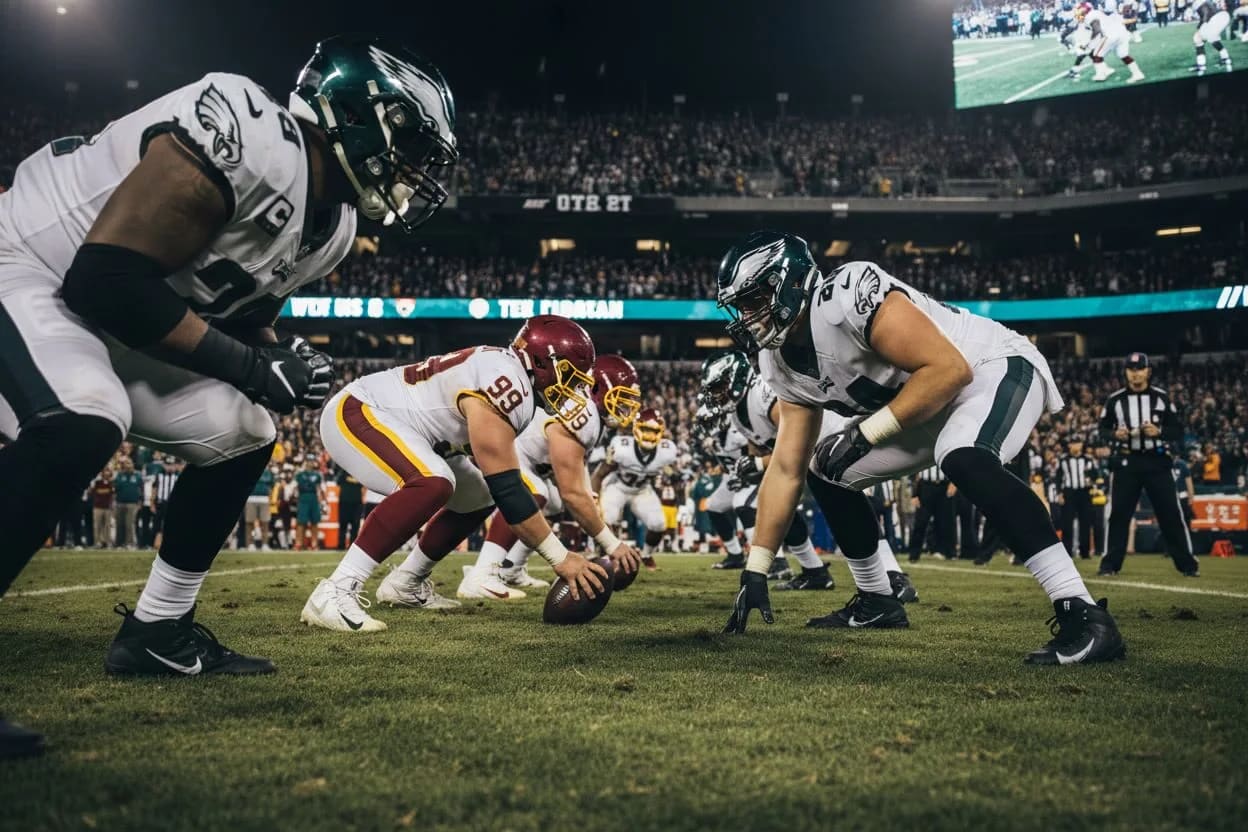

Eagles Commanders Point Spread Explained in Detail
The eagles commanders point spread is one of the most closely watched betting lines whenever these two NFC East rivals meet. The matchup carries weight beyond the standings. It blends divisional familiarity, coaching adjustments, quarterback dynamics, and market perception into a single number that bettors scrutinize relentlessly.
A point spread is not just a prediction. For bettors who want to understand how spreads are interpreted and exploited across NFL matchups, this guide on how to pick against the spread explains the logic behind margins, key numbers, and market movement in detail. It is a market-driven signal reflecting how sportsbooks and bettors expect the game to unfold. In NFL betting markets, point spreads are designed to attract roughly equal money on both sides, rather than predict an exact margin of victory. According to long-term betting data tracked across major sportsbooks, approximately 68–72% of NFL games close within one score (8 points or fewer), which is why spreads are often tightly clustered around key numbers like 3, 6, and 7.
When it comes to the Eagles and Commanders, that signal is often sharper, more volatile, and more reactive than non-divisional matchups. Since divisional opponents play each other twice per season, sportsbooks have significantly larger historical sample sizes for pricing these games compared to interconference matchups.
This article breaks down the Eagles Commanders point spread from every meaningful angle—how it’s set, why it moves, what historical patterns reveal, and how bettors interpret value without relying on surface-level narratives.
Understanding the Eagles vs Commanders Divisional Context
Divisional games behave differently. Familiarity compresses outcomes. Coaching staffs know tendencies. Players recognize formations. That alone impacts how the point spread is priced.
The Philadelphia Eagles and Washington Commanders face each other twice every regular season under the NFL divisional structure. Since the NFL expanded to a 17-game regular season in 2021, divisional games now account for 35% of a team’s regular-season schedule (6 of 17 games). That frequency materially affects how spreads perform.
League-wide data from the last decade shows that divisional underdogs cover the spread at a higher rate than non-divisional underdogs, typically ranging between 52% and 55% ATS, depending on the season. This trend is especially noticeable in matchups where teams share coaching trees or play similar defensive schemes, as is often the case in the NFC East.
Because of this divisional context, Eagles vs Commanders spreads are often tighter than public perception expects. Even when one team enters the matchup with a significantly better win-loss record, sportsbooks rarely inflate the line unless multiple reinforcing factors align.
This divisional context ensures the Eagles Commanders point spread reflects respect for volatility, not just power rankings. That volatility becomes clearer when viewed through long-term tendencies, and this breakdown of NFL team identity and betting value shows how repeatable traits shape spreads beyond short-term results.
How the Eagles Commanders Point Spread Is Set
The initial spread is released by oddsmakers using a composite of data inputs:
- Team power ratings derived from efficiency metrics, not standings
- Home-field adjustment
- Injury projections based on participation reports
- Rest and travel variables
- Weather expectations
- Recent performance efficiency, not just final scores
Power ratings themselves are typically calculated using net yards per play, success rate, third-down efficiency, red-zone efficiency, and turnover differential, all of which correlate more strongly with future performance than raw points scored.
Contrary to popular belief, sportsbooks do not “predict” the final score. They aim to open a number that attracts balanced action while staying close to the true expected margin. According to sportsbook risk disclosures, opening spreads are often adjusted within minutes of release if early sharp action identifies inefficiencies.
For Eagles vs Commanders games, oddsmakers must also price in public bias. The Eagles have ranked consistently among the top five most bet-on NFL teams over the last several seasons, particularly in prime-time games. This public tendency often pushes the spread 0.5 to 1 point toward Philadelphia compared to purely model-based projections.
The opening number is therefore not neutral. It is a strategic starting position.
Why the Point Spread Often Moves Before Kickoff
Line movement in Eagles vs Commanders games is rarely random. It usually falls into one of four categories:
- Injury confirmation
- Sharp money influence
- Weather updates
- Market overreaction
Injury-related movement is the most quantifiable. Historical NFL betting data shows that:
- A starting quarterback being ruled out can move a spread 3 to 7 points, depending on replacement quality.
- A starting offensive lineman typically moves a spread 0.25 to 0.5 points.
- A starting cornerback or pass rusher moves the line 0.5 to 1 point if matchup-dependent.
Sharp bettors tend to attack early. When respected money hits Commanders +points shortly after opening, sportsbooks adjust quickly, sometimes before public betting volume becomes visible. These moves are often referred to as “steam moves” and are logged across multiple sportsbooks simultaneously.
Weather also plays a measurable role. Games with sustained winds above 15 mph historically see lower scoring margins, which increases the value of underdogs and reduces the likelihood of large spreads covering.
Home Field Advantage in Eagles vs Commanders Spreads
Home field advantage still exists, but it is no longer the automatic three-point adjustment it once was. League-wide analysis since 2010 shows home-field advantage averaging between 2.2 and 2.7 points, depending on season and travel distance.
For Eagles vs Commanders games, the adjustment is often closer to 2 to 2.5 points, reflecting shorter travel distances and divisional familiarity. Short travel reduces fatigue-related variance, which is one reason divisional home edges are slightly smaller.
Philadelphia’s home environment can influence false starts and pre-snap penalties. Over the last several seasons, opposing offenses in Philadelphia have averaged 0.6 more false starts per game compared to their season averages.
Washington’s home field, while less intimidating historically, still alters preparation routines. Visiting teams still travel, adjust schedules, and play on a different surface, all of which sportsbooks account for.
Oddsmakers treat home field as a variable, not a constant. That nuance is especially visible in divisional spreads.
Historical Spread Performance Between Eagles and Commanders
Looking at recent seasons, Eagles vs Commanders games have produced mixed against-the-spread results. Favorites have not dominated consistently.
Across the last decade, this matchup has featured:
- Multiple games decided by one score or fewer
- Several outright underdog wins
- A higher-than-average number of games landing near key numbers like 3 and 7
Divisional familiarity contributes to this pattern. According to NFL ATS databases, divisional favorites of 6 points or more cover at a lower rate than non-divisional favorites in the same range.
This history does not guarantee future results, but it explains why sportsbooks rarely inflate the spread beyond a certain threshold without strong justification.
Key Matchup Factors That Influence the Spread
The Eagles Commanders point spread reacts strongly to specific matchup elements rather than generic team strength.
Quarterback Efficiency
Quarterback efficiency metrics—such as EPA per dropback, completion percentage under pressure, and turnover-worthy play rate—are among the strongest predictors of spread movement.
If the Eagles’ quarterback enters the game ranking in the top third of the league in EPA per play, sportsbooks are more willing to price Philadelphia as a larger favorite. Conversely, if Washington’s quarterback demonstrates improved pocket stability and a reduction in turnover rate, spreads tighten quickly.
Quarterback perception moves numbers faster than almost any other variable.
Trenches and Line Play
Offensive and defensive line mismatches matter deeply in this rivalry. League-wide data shows teams that win the yards-before-contact battle cover spreads at a higher rate than those that lose it.
When the Eagles’ offensive line controls the line of scrimmage, time of possession increases, variance decreases, and expected margins rise. If Washington’s defensive front generates pressure without blitzing—something that correlates strongly with limiting explosive plays—sportsbooks reduce projected scoring margins accordingly.
Coaching Tendencies
Coaching aggressiveness directly affects spread outcomes. Teams that rank higher in fourth-down aggressiveness metrics tend to outperform expectations when favored and limit downside risk when underdogs.
When coaches play conservatively with a lead, favorites often fail to cover. When underdogs stay aggressive, spreads compress. Sportsbooks model these tendencies using historical decision-making data.
Public Perception vs Market Reality
One of the most important dynamics in the Eagles Commanders point spread is the gap between public belief and market truth.
Public bettors often anchor to:
- Recent highlight performances
- Standings position
- Media narratives
Markets respond to:
- Efficiency metrics
- Injury probability distributions
- Matchup-specific tendencies
This divergence creates opportunity. To understand why those gaps matter over time, this value betting explained guide breaks down how probability mismatches between perception and pricing create sustainable betting edges. Data from sportsbook handle reports shows that public betting percentages often exceed 65% on popular teams, while closing lines frequently move in the opposite direction due to sharp action.
Timing the Spread: Early vs Late Betting
Timing matters as much as direction.
Early lines are shaped by sharp bettors and internal models. Late lines are shaped by public volume and confirmed information.
In Eagles vs Commanders games:
- Early bettors often target underdogs
- Late bettors often chase favorites
- Closing lines frequently reflect public bias
Historical closing-line value studies show bettors who beat the closing number outperform long-term averages.
Weather and Its Underrated Impact
Weather is not a footnote in NFC East football. Cold, wind, and rain alter play selection and scoring expectations.
Games played in temperatures below 40°F historically show reduced scoring efficiency, while wind above 15 mph lowers passing success rates and increases run frequency.
When weather deteriorates, spreads tend to move toward the underdog. Low-scoring games magnify every point.
Prime Time vs Day Games
Prime-time NFL games attract significantly higher betting volume. Public betting share increases, particularly on popular teams.
In prime time, spreads involving high-profile teams are more likely to inflate. Day games generally see more balanced action and less emotional betting.
This situational dynamic consistently affects Eagles Commanders spreads.
Injuries and Late-Week Volatility
Late-week injury reports create some of the sharpest line movements.
NFL injury reporting rules require final designations by the end of the week, and sportsbooks react immediately. Bettors who understand depth charts and scheme fit are better positioned to evaluate whether a listed injury materially changes expected margin.
Reading the Spread Without Overthinking It
One mistake bettors make is assuming the spread “knows” something hidden. It doesn’t.
The spread reflects probabilities, incentives, and risk balancing. Understanding how it’s formed allows bettors to interpret rather than guess.
Why This Matchup Continues to Attract Attention
Eagles vs Commanders games sit at the intersection of rivalry, market bias, and tactical nuance. That combination makes the point spread more informative than most.
It forces sportsbooks to balance brand power with realism and bettors to separate emotion from evidence.
How the Number Ultimately Tells the Story
The eagles commanders point spread is not about picking sides. It is about understanding structure, context, and information flow.
When you break it down—divisional dynamics, matchup variables, public behavior, quantified trends, and timing—you see the spread for what it truly is: a market-driven number shaped by data and incentives.
That understanding is what transforms betting from reaction into discipline.
Frequently Asked Questions
More blogs

Wagering Meaning: What Does Wagering Mean in Betting and Gambling?
23 Sept 2025

Unpacking the Odds: What 'Over 2.5 Goals' Means for Your Football Bets
03 Oct 2025

Mastering the Under 2.5 Goals Betting Strategy
06 Oct 2025

Understanding the "Both Teams to Score" (BTTS) Market: A Comprehensive Guide
08 Oct 2025
Sports Betting Blogs
Mastering the Under 2.5 Goals Betting Strategy
. 06 Oct 2025