
Crash Games vs Slots: Which Gives Better Value in 2026?
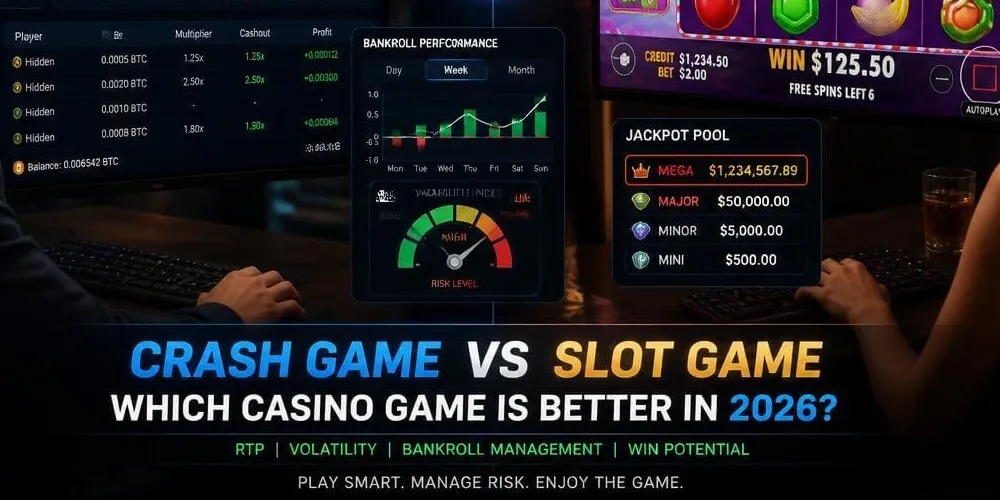

Crash Games vs Slots: Which Casino Game Gives Better Value in 2026?
Crash games and slots are two of the most popular casino formats in 2026, but they do not give value in the same way.
Slots are built around entertainment, bonus rounds, themes, and jackpots. Crash games are built around speed, multipliers, and player decisions. That difference matters because better value is not always about the biggest possible win.
For most experienced crypto casino players, crash games can offer better mathematical value because RTP is often higher and outcomes feel more transparent. For beginners, casual players, and jackpot hunters, slots still offer better entertainment value.
So the real question is not only, “Which game pays more?” The better question is, “Which game gives your bankroll the best chance to last while still giving you a fair shot at meaningful returns?”
What Does Better Value Actually Mean in Casino Gaming?
Most players compare crash games and slots the wrong way. They look at the biggest multiplier, the flashiest bonus round, or the jackpot size. That is fun, but it is not a complete way to judge value.
Better value in casino gaming means the game gives a fair balance between payout potential, entertainment, risk, and session length. A game can have massive upside and still be poor value if it burns through your bankroll too quickly.
A 10,000x crash multiplier looks exciting. A slot bonus that can pay 5,000x also looks exciting. But if the chance of hitting those outcomes is extremely low, the headline payout does not tell the full story.
Value Is Not Just Winning
Value comes from several factors working together:
- RTP
- Volatility
- Session length
- Entertainment quality
- Bonus opportunities
- Bankroll survival
- Game speed
- Player control
This is why the best casino games 2026 players should consider are not always the games with the biggest possible payout. Sometimes the better game is the one that gives you more playable time, clearer rules, and fewer emotional traps.
Why Crash Games Became One of the Fastest-Growing Casino Formats
Crash games became popular because they are easy to understand in seconds. The multiplier rises. You cash out before it crashes. That is the whole idea.
This simplicity made the crash gambling game format perfect for crypto casinos. Crash games gained momentum during the growth of crypto casinos because they aligned with the preferences of early crypto users. Fast transactions, immediate results, transparency tools, and community-driven gameplay all matched the culture of crypto gambling far more closely than traditional slot machines. Crypto players often prefer fast deposits, quick withdrawals, and instant-style games. Crash games fit that behavior better than slow-loading slots with long animations.
Another reason crash games grew so quickly is that they feel interactive. Players are not just pressing spin and waiting. They are watching the multiplier rise and making a decision before the round ends.
That decision creates tension. It also creates the feeling of control. That feeling is powerful, even though the casino still has a mathematical edge.
Crash Game Evolution
- Early crypto casinos introduced crash games as simple multiplier games.
- Provably fair systems helped build trust with crypto players.
- Streamers made big multiplier moments more visible.
- Mobile-first casinos made crash games easier to play anywhere.
- By 2026, many crypto casinos place crash games beside slots as core casino products.
This explains why crypto crash game searches have grown around value, strategy, and high multiplier potential. Players are no longer asking only how crash games work. They want to know if crash games are actually better than slots.
How Slots Continue to Dominate Online Casino Revenue
Slots are still the heavyweight of online casino gaming. In most regulated online casino markets, slots account for well over half of total casino revenue, often significantly outperforming table games and newer formats combined. This dominance helps explain why operators continue investing heavily in slot development despite the rapid growth of crash games. They are simple, colorful, and easy for beginners to understand. Press spin, watch the reels, and wait for the result.
That simplicity is a huge advantage. A new player does not need to understand multipliers, cashout timing, or betting systems before playing. Slots remove decision pressure.
Slots also offer variety that crash games cannot match. There are sports slots, mythology slots, movie-style slots, fruit slots, jackpot slots, Megaways-style games, and bonus-heavy video slots. If one theme feels boring, another one is always available.
Bonus rounds are another major reason slots remain dominant. Free spins, wilds, multipliers, expanding reels, and jackpot features give players a reason to keep playing. The game sells anticipation very well.
Expert Note
Slots dominate casino revenue because they combine:
- Simple gameplay
- Thousands of themes
- Bonus features
- Progressive jackpots
- Strong mobile compatibility
- Longer entertainment sessions
Few casino products retain casual players as effectively as slots. Crash games may feel sharper and faster, but slots still win the entertainment battle for many users.
One reason casinos continue prioritizing slots is revenue predictability. High-volatility games also create marketing advantages for operators. Large wins generate screenshots, social media posts, streamer content, and word-of-mouth promotion. A single player winning 5,000x attracts more attention than hundreds of players experiencing average results, even though the mathematical return of the game remains unchanged. Slot RTP is often distributed across bonus features, jackpots, and long-term play cycles, which encourages longer average sessions. Crash games are faster and more transparent, but many players cash out quickly or leave after short sessions. Industry reports consistently show slots generating the largest share of online casino revenue because they keep players engaged for longer periods.
The Mathematics Behind Value: RTP vs Volatility
RTP stands for Return to Player. The opposite side of RTP is known as hold percentage, which represents the portion of wagers retained by the casino over time. A game with 97% RTP has a theoretical hold of roughly 3%. Understanding both RTP and hold helps players evaluate games from both the player and operator perspective rather than focusing on returns alone. If a game has 97% RTP, it means the game is programmed to return 97% of wagered money over a very large number of rounds. The house edge would be around 3%.
That sounds simple, but players often misunderstand it. RTP does not mean you will get $97 back from every $100 session. Professional players often separate long-term RTP from expected session value. Even a game with favourable RTP can produce negative short-term outcomes because expected value only becomes reliable over a very large number of wagers. This distinction helps explain why individual sessions frequently differ from theoretical expectations. It is a long-term mathematical average, usually measured across huge game volume.
Volatility explains how rough the ride can be. A low-volatility game pays smaller wins more often. A high-volatility game may pay rarely, but the winning rounds can be much larger.
This is where crash games and slots become difficult to compare. A crash game may advertise a high RTP, but if you chase extreme multipliers, your session can end very quickly. A slot may have lower RTP, but if it pays small hits often, your bankroll may last longer.
Imagine Two Games
Game A:
- RTP: 99%
- Very high volatility
- Rare large wins
- Fast gameplay
Game B:
- RTP: 96%
- Moderate volatility
- More frequent small wins
- Slower gameplay
On paper, Game A looks better. In real play, Game B may feel better for many players because the bankroll lasts longer. That longer session can create more entertainment value.
This is why high payout casino games are not always the best games for every player. High payout potential means very little if the game destroys your balance before you can benefit from it.
Key Insight
Volatility often affects real player experience more than RTP. RTP tells you the long-term math. Volatility tells you how painful the short term may feel. Professional gamblers refer to this as risk of ruin: the chance of losing a bankroll before long-term probabilities have time to work. Two games can have similar RTP figures, yet the game with higher volatility usually creates a much greater risk of ruin for players using small bankrolls.
Why RTP And Value Are Not The Same Thing
Many casino players treat RTP as the ultimate measure of value. The logic seems simple: if one game returns 99% of wagers over time and another returns 96%, the 99% game must be the better choice. In reality, RTP is only one part of the equation.
RTP measures long-term mathematical expectation. Value measures the actual experience a player receives from a game. Those two things are connected, but they are not identical. A game can have a higher RTP while still producing a worse experience for a large percentage of players.
Consider three different players.
Player A: The High-RTP Chaser
Player A chooses a crash game with 99% RTP. On paper, this looks like a smart decision. However, the player targets 100x multipliers and refuses to cash out early.
The problem is that extreme multiplier strategies create long losing streaks. Even though the RTP is excellent, the player may lose an entire bankroll before ever reaching one of those large wins. The mathematics are attractive, but the practical outcome can be disappointing.
Player B: The Conservative Slot Player
Player B chooses a low-volatility slot with 96% RTP. The RTP is lower, but the game provides frequent small wins, occasional bonus features, and longer playing sessions.
This player may lose money more slowly while enjoying a steadier experience. From a mathematical perspective, the RTP is worse. From an entertainment perspective, the value may actually be higher.
Player C: The Disciplined Crash Player
Player C chooses a crash game with 97% RTP and uses a disciplined approach. Stakes remain small, auto cashout is enabled, and session limits are respected.
This player is not trying to predict crashes or chase huge multipliers. Instead, the focus is on controlling risk and protecting the bankroll. Although the RTP is lower than Player A's game, the overall experience may be significantly better because the strategy aligns with the game's volatility.
The Key Lesson
RTP tells you how much money a game is expected to return over millions of rounds. Value tells you how useful, enjoyable, and sustainable that game is for an individual player.
A higher RTP does not automatically create higher value. Volatility, session length, bankroll management, entertainment quality, and player behavior all influence whether a game actually feels worthwhile.
This is why experienced players rarely evaluate casino games using RTP alone. The best value usually comes from finding the balance between mathematical return and practical playability rather than chasing the highest percentage on the screen.
Why Most Players Judge Casino Value Incorrectly
Most casino players believe value is determined by one thing: how much money a game can potentially pay. That sounds logical, but it often leads players to choose games that are actually poor fits for their bankroll, risk tolerance, and playing style.
One common mistake is focusing entirely on RTP. A player sees a crash game with 99% RTP and immediately assumes it offers better value than a slot with 96% RTP. In reality, the higher RTP game may also have much higher volatility, which means many players will experience larger swings and a greater chance of losing their bankroll before the theoretical RTP has time to work in their favor.
Another mistake is judging games by their biggest advertised win. Casinos love marketing huge multipliers, jackpot payouts, and life-changing prizes because they attract attention. The problem is that payout potential and probability are completely different things. A game can advertise a 10,000x win while the vast majority of players never come close to experiencing it.
Many players also ignore session value. Two games may produce identical losses over time, but one game might provide an hour of entertainment while the other empties a bankroll in ten minutes. For recreational players, that difference can be more important than RTP, volatility, or even winning potential.
Risk tolerance is another factor that players often overlook. Some people enjoy the adrenaline of chasing large multipliers. Others prefer smaller wins that keep a session alive longer. Value depends heavily on matching the game to the player rather than chasing the highest advertised returns.
Common Value Mistakes Players Make
- Focusing only on RTP
- Chasing the biggest advertised payouts
- Ignoring volatility
- Ignoring bankroll lifespan
- Confusing entertainment with profitability
- Assuming faster games create more opportunities to win
- Believing previous outcomes influence future results
The strongest way to evaluate any casino game is to combine multiple factors rather than relying on a single statistic. RTP, volatility, session length, entertainment value, bankroll survival, and personal goals all contribute to whether a game actually delivers good value. Players who understand this usually make better decisions than those who focus only on multipliers or jackpots. Understanding value is one thing. Applying that knowledge during real gameplay is another. This is where strategy becomes important.
Crash Games vs Slots: Key Differences That Affect Your Wallet
Player Control
Crash games give players a decision every round. You decide whether to cash out early or wait for a bigger multiplier. That decision creates pressure because your timing directly affects the payout.
Slots give far less control. You choose your bet size, paylines, and sometimes bonus options. After that, the spin result is handled by the game.
This is why crash games feel more active. Slots feel more passive. One reason crash games feel fundamentally different is decision frequency. A slot player may make only a handful of meaningful decisions during a session, while a crash player makes decisions every round. This increased decision frequency creates greater engagement but can also accelerate emotional mistakes when discipline breaks down. Neither format is automatically better, but the wallet impact is different.
Session Speed
Crash games are fast. Some rounds end almost instantly. If you keep clicking without a plan, your bankroll can disappear faster than expected.
Slots are also fast, but animations, bonus teases, and free spin features often slow the session down. That can protect casual players from burning through stakes too quickly.
- Fast gameplay is exciting, but it is also dangerous. The faster the game, the easier it becomes to lose track of total wagers. A 2% or 3% house edge may sound small, but game speed changes how often that edge is applied. A player making hundreds of crash bets per hour can expose far more money to the house edge than someone playing slower slot sessions, even when the advertised RTP is similar.
For example, a player wagering $2 across 500 crash rounds exposes $1,000 to the game's house edge. A slower slot player making 150 spins at the same stake exposes only $300. Even with similar RTP figures, the faster player experiences variance and expected losses much more quickly.
Winning Frequency
Crash games can create frequent small wins if you cash out early. For example, a player using 1.3x or 1.5x targets may win several rounds in a row.
The problem is that one failed cashout can erase multiple small wins. That is the hidden danger of low multiplier strategies.
Slots often provide small base-game wins, but larger returns usually come from bonus features. If the bonus round does not trigger, the session can feel slow and frustrating.
Emotional Pressure
Crash games create FOMO. You may cash out at 2x and then watch the multiplier climb to 100x. That hurts, even if your decision was correct.
Slots create a different type of frustration. Near misses, bonus teases, and dead spins can push players to keep spinning longer than planned. One interesting difference is that slots often hide volatility better than crash games. A crash game immediately reveals a losing round when the multiplier crashes early. Slots can disguise losing sessions through small payouts, near misses, bonus animations, and feature teases. As a result, players sometimes underestimate how much they are actually losing during long slot sessions.
Both games use emotion. Crash games use pressure. Slots use anticipation.
Entertainment Style
Crash games are direct. They are clean, fast, and intense. The entertainment comes from watching the multiplier climb.
Slots are more layered. Themes, sounds, animations, and bonus rounds create a fuller entertainment experience.
If you want quick action, crash games feel better. If you want a more relaxed casino session, slots usually offer more variety.
Do Crash Games Have Better Odds Than Slots?
Crash games often have better odds on paper. Many crash games, especially at crypto casinos, advertise RTP figures around 97% to 99%. By comparison, many popular online slots operate between 94% and 97% RTP, although individual games can fall outside that range. The difference may appear small, but over thousands of wagers it can have a measurable impact on expected losses. Many online slots sit closer to 94% to 97%, depending on the game and provider.
That makes crash games look like the better value choice. In many cases, they are. But only if the player uses disciplined staking and realistic cashout targets.
The problem is that crash game behavior can ruin the advantage. A player chasing 50x, 100x, or 500x every round may experience brutal losing streaks. The RTP might still be strong, but the bankroll may not survive long enough.
Player A
- Bets $5 per round
- Uses 1.5x auto cashout
- Accepts smaller wins
- Stops after reaching a limit
Player B
- Bets $5 per round
- Waits for 100x
- Refuses early cashouts
- Keeps raising stakes after losses
Both players are using the same crypto crash game. Their results can still look completely different. The game math is the same, but the risk profile is not.
Verdict
Do crash games have better odds than slots? Often yes, based on RTP. But crash games only give better value when the player avoids reckless multiplier chasing. One of the biggest misconceptions about crash games is that success comes from predicting future multipliers. In practice, most long-term results are driven by discipline rather than prediction. Players cannot reliably forecast when a crash will occur, but they can control stake size, session length, and cashout behaviour. This means the skill in crash games comes from risk management rather than forecasting outcomes.
Crash Game Strategy for Beginners in 2026
A crash game strategy for beginners should be boring. That may sound strange, but boring strategies usually protect bankrolls better than exciting ones.
The main goal is not to hit the biggest multiplier. The first goal is to stay in control. If you cannot control bet size, session length, or cashout targets, the game will control you.
Auto cashout is one of the most useful tools for beginners. It removes hesitation and panic from the round. You choose your cashout point before the multiplier starts climbing.
Crash Game Strategy Checklist
- Set a fixed session budget before playing.
- Use auto cashout if timing pressure affects your decisions.
- Keep stakes small compared with your bankroll.
- Avoid chasing losses after early crashes.
- Use realistic multiplier targets.
- Stop after reaching your win or loss limit.
- Do not raise stakes because a “big one feels due.”
Common Beginner Mistakes
- Chasing 100x multipliers too often.
- Increasing stake size after losing rounds.
- Ignoring session limits.
- Believing previous crashes predict future rounds.
- Cashing out randomly with no plan.
The best crash game strategy for beginners 2026 is usually the least dramatic one. Survive first. Chase profit second. Ignore the highlight clips unless you enjoy learning expensive lessons.
Many experienced gamblers use a bankroll technique known as position sizing. Instead of focusing on the amount of money being wagered, they focus on the percentage of their bankroll at risk on each bet. For example, a player with a $200 bankroll might limit individual wagers to 1% to 2% of the total balance. This approach reduces the impact of losing streaks and helps preserve capital long enough for long-term probabilities to play out. Whether playing crash games or slots, position sizing is often more important than finding the highest RTP game.
Slots Bonus Round vs Crash Multiplier: Which Has More Realistic Upside?
Slots and crash games both offer big payout potential, but they reach that upside differently.
A crash multiplier is visible every round. You can see it climb in real time. If it reaches 10x, 50x, or 100x, you know exactly what the payout would be.
A slot bonus round is different. You may need scatters, special symbols, or a feature trigger before the larger payout opportunity begins. That makes slots feel slower, but the bonus can be more entertaining.
Example Scenario
Player One:
Hits a 50x crash multiplier on a $5 bet.
Player Two:
Triggers a slot bonus round that pays 300x on a $5 bet.
Player One gets the faster result. Player Two gets the more cinematic result. The slot bonus may be harder to trigger, but it can create a larger entertainment moment when it lands.
The important point is probability. A 300x bonus round sounds better than a 50x crash cashout, but if it appears rarely, the real value may be lower for short sessions.
Verdict
Crash multipliers offer more frequent decision points. Slot bonus rounds offer bigger entertainment peaks. Potential and probability are not the same thing.
Which Game Drains a Bankroll Faster?
Bankroll survival is one of the best ways to compare crash games and slots. A game is not good value if it gives you five minutes of action and then empties your balance.
A $100 bankroll can behave very differently depending on the game and strategy. This is why game choice matters less than game behavior.
Player One: Aggressive Crash Player
This player has a $100 bankroll and bets $10 per round. They chase 20x, 50x, or 100x multipliers.
The upside is obvious. One good hit can create a major return. The downside is worse. Ten failed rounds can end the session.
This player may blame bad luck, but the real issue is risk exposure. The strategy gives the bankroll very little room to breathe.
Player Two: High-Volatility Slot Player
This player also has $100 and plays a high-volatility slot at $2 per spin. The session lasts longer than the aggressive crash session, but the risk is still high.
High-volatility slots can run cold for long periods. If the bonus does not trigger, the player may slowly lose the full balance.
The emotional trap here is different. The player keeps thinking, “The bonus must be close.” It may not be.
Player Three: Conservative Crash Player
This player has the same $100 bankroll but bets $2 per round and uses auto cashout between 1.3x and 2x.
This does not guarantee profit. No casino strategy does. But the session has more structure and less panic.
The player is less likely to lose everything in a few rounds. That gives the bankroll more time and reduces emotional damage.
Bankroll Takeaway
Crash games can drain a bankroll faster because rounds are quick and full-loss outcomes are common. Slots can drain a bankroll slowly through dead spins and bonus chasing. In both cases, poor staking is the real enemy. If bankroll management explains part of the outcome, player psychology explains the rest. The way players interpret wins, losses, and decision-making often has a major impact on long-term results.
Why Many Players Think Crash Games Are More Skill-Based Than They Really Are
Crash games feel skill-based because the player makes a decision. You choose when to cash out.
Fast-paced games often create the illusion that they are easier to beat. Because players make many decisions in a short period, they receive more immediate feedback and become more confident in their ability to influence outcomes. This confidence can grow even when the underlying mathematics of the game remain unchanged.
But there is a difference between decision-making and true skill. You can make a smart cashout decision and still lose the next round. You can make a bad decision and get lucky.
This creates an illusion of control. Players start believing they can “read” the game. They watch previous rounds and look for patterns that are not reliable.
Crash games are still casino games. The house edge remains. Cashout timing affects your personal risk, but it does not remove the mathematical advantage built into the game. Behavioural researchers have found that players often overestimate their influence whenever a game contains a decision point. Choosing when to cash out feels strategic because the outcome appears connected to a personal action. In reality, the decision changes risk exposure rather than the mathematical edge. This helps explain why many crash players believe they can identify patterns or develop systems that consistently beat the game, even though every round remains independent.
Psychology Box
Players often confuse:
- Decision-making
- Skill
- Control
- Luck
- Pattern recognition
These are not the same thing.
A crash game gives you control over when to exit. It does not give you control over when the game crashes. That distinction is crucial. Because different players respond differently to risk, volatility, and decision-making, the better choice often depends on the individual rather than the game itself.
Which Game Gives Better Value for Different Types of Players?
For Beginners
Slots usually give better value for complete beginners. They are easier to understand, easier to play, and less stressful in real time.
Crash games are simple, but they demand discipline. A beginner who cannot handle fast decisions may lose control quickly.
Best beginner choice: Slots.
For Low Bankroll Players
Low bankroll players need session survival. They should avoid high-stakes crash rounds and high-volatility slots.
A conservative crash strategy can work, but low-volatility slots may feel easier and calmer. The right choice depends on whether the player wants active or passive play.
Best low-bankroll choice: Low-volatility slots or low-stake crash with auto cashout.
For Bonus Hunters
Slots often give better value for bonus hunters because casino promotions are usually built around slots. Free spins, wagering offers, bonus rounds, and game-specific campaigns are common.
Crash games may be excluded from some bonuses or may contribute less to wagering. That detail matters before claiming any offer.
Best bonus hunter choice: Slots. However, bonus hunters should always check wagering requirements and eligible game contributions before playing. A generous-looking slot bonus can provide less real value than expected if wagering conditions are difficult to complete.
For High-Risk Players
High-risk players may prefer crash games because the multiplier potential is visible and immediate. The game gives them fast access to big outcomes.
That does not mean it is safer. In fact, crash games can punish high-risk behavior very quickly.
Best high-risk choice: Crash games, but only with strict limits.
For Crypto Casino Users
Crypto casino users often prefer crash games because they match the style of crypto gambling. Fast rounds, instant settlement, and provably fair systems fit the market well.
Slots are still popular at crypto casinos, but crash games feel more native to the crypto casino experience.
Best crypto casino choice: Crash games.
For Casual Entertainment
Slots usually win for casual entertainment. They offer more themes, more sounds, more features, and more variety.
Crash games can become repetitive if the player is not deeply interested in multiplier decisions.
Best casual choice: Slots.
Another factor worth considering is entertainment value per dollar. Many recreational players are not trying to maximize expected value or RTP. They simply want the most enjoyable experience for their budget. A slot session that provides an hour of gameplay, several bonus features, and steady engagement may feel more valuable than a crash session that ends after a few minutes, even if the crash game offered slightly better theoretical returns.
For Long Sessions
Slots often provide longer sessions because the pace can be slower. Low-volatility slots can stretch bankrolls better than aggressive crash play.
Crash games can also last if the player uses small stakes and early cashouts, but the temptation to speed up is always there.
Best long-session choice: Slots for most players, conservative crash for disciplined players.
Which Game Fits Your Bankroll?
- Under $50 bankroll: Low-volatility slots or conservative crash strategies.
- $50–$200 bankroll: Either format can work, depending on risk tolerance.
- $200+ bankroll: Players can tolerate more volatility and may benefit from exploring higher-risk crash or slot strategies.
The smaller the bankroll, the more important session survival becomes. Players with limited funds should generally prioritise lower volatility and disciplined stake sizing over maximum payout potential.
Best Crypto Crash Games To Play In 2026
The best crash games to play at crypto casino 2026 platforms are the ones that combine clear rules, visible multipliers, simple cashout options, and transparent fairness details.
Players should look beyond the biggest multiplier shown on the screen. A good crash game should make bet size, auto cashout, result history, and fairness information easy to understand.
Mobile performance also matters. Crash games are fast, so delays, lag, or confusing buttons can create real problems.
Popular Crash Games
- Stake Crash
- BC.Game Crash
- BetFury Crash
- Roobet Originals
- Other crypto casino originals with provably fair details
The best crash games online are not always the loudest games. They are the games that make risk clear and give players the tools to manage it.
When Slots Are The Better Choice
Slots are better when the player wants entertainment first. If the goal is to relax, enjoy themes, trigger bonus rounds, and play without fast decisions, slots make more sense.
They are also better for jackpot hunters. Crash games can produce large multipliers, but slots often offer progressive jackpots and feature-heavy payout structures.
Slots are usually better if you:
- Enjoy jackpot potential
- Prefer passive gameplay
- Like free spins and bonus rounds
- Want more visual variety
- Play mainly for entertainment
- Prefer slower sessions
The main warning is volatility. A fun-looking slot can still be expensive if the bonus feature rarely lands.
When NOT To Play Slots
Slots are not always the best option. Players who become frustrated by long losing streaks, frequent dead spins, or waiting for bonus features may find slots less satisfying than crash games.
They may also be a poor choice for players who enjoy making active decisions during gameplay. Once a spin starts, the outcome is largely out of the player's hands.
If transparency and immediate feedback are priorities, crash games often provide a more engaging experience.
When Crash Games Are The Better Choice
Crash games are better when the player wants speed, transparency, and active decision-making. They suit players who enjoy watching risk unfold in real time.
They may also be better for players focused on RTP and simple game mechanics. There are fewer distractions than slots, and the payout structure is easier to understand.
Crash games are usually better if you:
- Prefer visible multipliers
- Enjoy active decisions
- Want quick sessions
- Play mainly at crypto casinos
- Like auto cashout tools
- Care about transparent gameplay
The main warning is emotional control. Crash games can make players chase too often, especially after watching a multiplier climb after they already cashed out.
When NOT To Play Crash Games
Crash games are not ideal for every player. If you struggle with impulsive decisions, frequently chase losses, or find yourself increasing stake sizes after missing a large multiplier, crash games can become expensive very quickly.
They may also be a poor fit for players who prefer long entertainment sessions. Because rounds finish rapidly, bankrolls can disappear faster than expected when discipline slips.
Players looking primarily for bonus features, jackpots, or passive gameplay often receive more value from slots than from crash games.
Final Verdict: Crash Games vs Slots in 2026
Crash games and slots both belong among the best casino games 2026 players should understand. But they serve different types of value.
For mathematical value, crash games often win because RTP can be higher and the game format is more transparent. For entertainment value, slots still win because they offer themes, bonuses, jackpots, and longer casual sessions.
For beginners, slots are usually the safer starting point. For experienced crypto casino players, crash games can offer better value if the player uses clear limits and avoids reckless multiplier chasing.
Winner By Category
Best for beginners:
Slots
Best for entertainment:
Slots
Best for transparency:
Crash games
Best for RTP-focused players:
Crash games
Best for jackpot potential:
Slots
Best for crypto casino users:
Crash games
Best for long sessions:
Slots
Best for disciplined strategy:
Crash games
So, crash games vs slots which is better 2026? If value means entertainment, slots remain the stronger choice. If value means transparency, speed, and higher theoretical returns, crash games have the stronger case. The biggest trade-off is transparency versus entertainment. Crash games make risk highly visible and give players more control over exits. Slots provide richer entertainment, larger feature variety, and more immersive gameplay. Neither advantage is universally better, which is why player goals matter more than game popularity.
The smart player does not choose based on hype. They choose based on bankroll, risk tolerance, and session goals. Many experienced casino players do not choose exclusively between crash games and slots. Instead, they use each format for different purposes. Crash games may be used for shorter, strategy-focused sessions, while slots are used for longer entertainment sessions and bonus hunting. Treating them as complementary rather than competing options often creates a better overall casino experience. That is where real value starts.
Frequently Asked Questions
More blogs




Crypto Casino Blogs