3 Point Contest Prediction
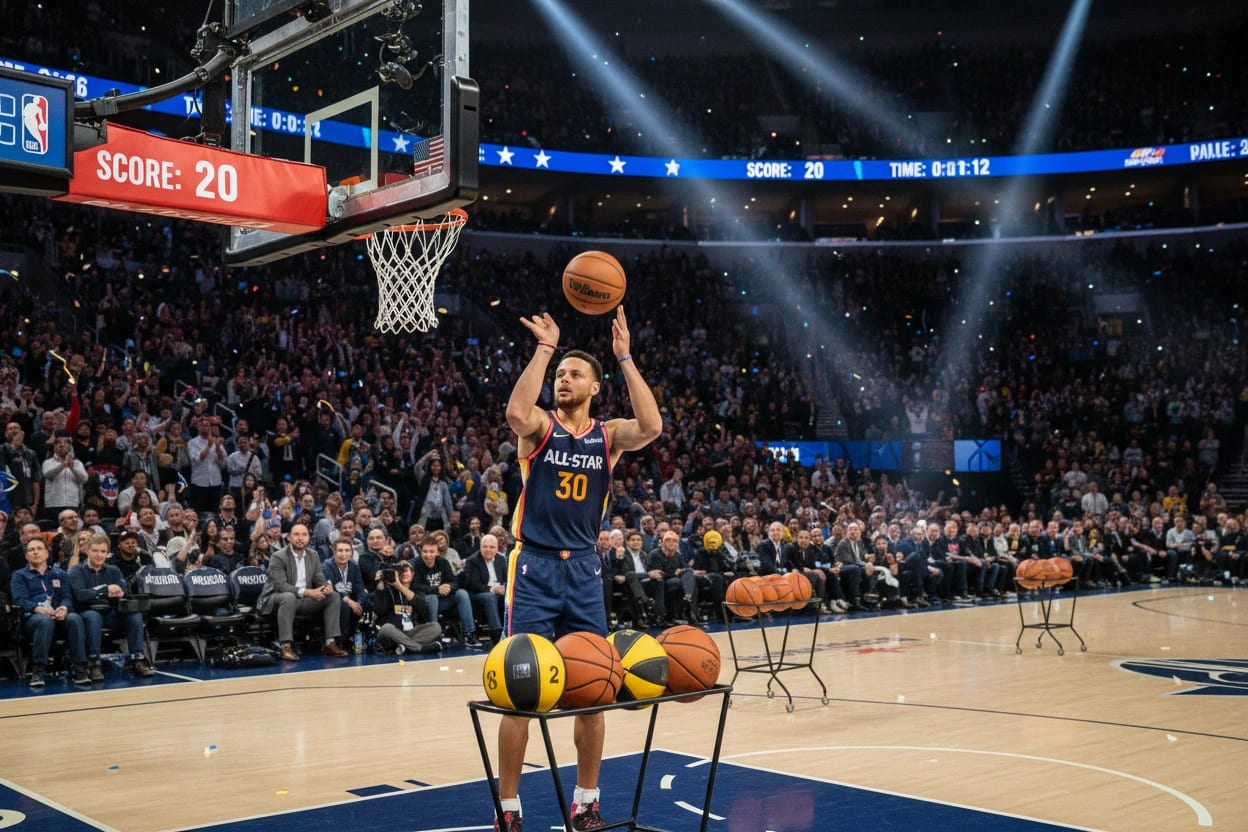

The NBA Three-Point Contest looks like the simplest event of All-Star Weekend. One player. One rack. One shot after another. Yet year after year, it produces results that surprise casual fans and punish surface-level predictions.
A reliable 3 point contest prediction cannot be built on regular-season shooting percentages alone. It requires understanding repetition shooting, time pressure, rack sequencing, fatigue across rounds, and how players respond when rhythm breaks. This contest is not a shooting contest in the traditional sense. It is a stress test of mechanics, pacing, and mental control.
This article breaks down every meaningful variable that shapes the Three-Point Contest outcome and explains how to evaluate them correctly. Nothing is filler. Every section exists to help you make a sharper prediction.
What Makes the Three-Point Contest Different From Game Shooting
Game shooting is reactive. Contest shooting is repetitive.
During a regular game, shooters adjust to defenders, spacing, and movement. They take different types of threes: pull-ups, relocations, late-clock attempts, and shots after physical contact. The contest removes all of that.
Every shot comes from the same spots, with the same ball sequence, under the same time constraint. This turns the event into a muscle-memory competition rather than a pure shooting showcase.
That distinction alone eliminates many elite shooters from serious consideration. Players who rely on dribble rhythm or variable footwork often struggle because the contest forces them into a fixed motion pattern they do not normally use.
A smart 3 point contest prediction starts by separating who shoots well in games from who shoots the same shot perfectly over and over.
How the Contest Format Shapes Outcomes
Each shooter moves through five racks placed around the arc. Every rack contains four standard balls and one money ball, with money balls worth double. Shooters can choose two full money-ball racks, which immediately introduces strategy.
There is a strict time limit. Shooters cannot pause to reset mentally. Misses compound quickly. Movement efficiency becomes critical.
Because of this format, players with compact releases and minimal foot movement gain an advantage. Long shooting motions eat into the clock and create pressure that does not exist during games.
Over time, changes to the format have quietly reshaped outcomes. When the clock was shortened compared to earlier eras, shooters who took longer to load the ball or reset their feet saw their scores drop relative to faster shooters. This is one of the most overlooked reasons why certain players dominate across multiple contests while others fade despite strong reputations.
Understanding this structural pressure is essential if you want your 3 point contest prediction to hold up beyond surface logic.
Why Season Three-Point Percentage Is Overvalued
Season-long shooting percentages reflect thousands of shots taken under varying conditions. The contest compresses everything into one short burst.
High-percentage shooters often benefit from selective shot profiles in games. They take open looks created by teammates, avoid rushed attempts, and shoot within offensive systems that maximize their comfort. The contest strips that protection away.
Meanwhile, some players with slightly lower percentages thrive because they take more difficult shots in games but have excellent mechanical consistency on stationary attempts.
Historical results show a clear pattern: contest winners frequently come from outside the top tier of regular-season percentage leaders. This is not coincidence. It reflects the difference between efficiency over volume and execution under repetition.
If your 3 point contest prediction relies heavily on season percentages alone, it is likely incomplete.
The Role of Release Speed and Shot Economy
Release speed matters more than raw shooting form.
In the contest, every fraction of a second saved allows a shooter to maintain rhythm instead of rushing late shots. Players with quick, direct releases can afford a miss without panic. Slower shooters often feel pressure after one miss and begin to accelerate unnaturally, leading to compounding errors.
Shot economy also plays a role. Some shooters waste motion by over-dipping the ball or stepping wide between racks. Others move efficiently, keeping their body aligned throughout the entire sequence.
These differences are subtle but decisive. When scores are separated by two or three points, movement efficiency can be the difference between advancing and elimination.
A strong 3 point contest prediction accounts for how efficiently a shooter moves, not just how well they shoot.
Money Ball Rack Strategy and Comfort Zones
Money-ball racks are where contests are won.
Shooters must decide where to place their two full money racks. Most choose between the corners and the top of the key. This choice reflects both shooting comfort and movement preference.
Corner racks favor shooters who set their feet quickly and shoot with minimal lateral drift. The top of the key favors symmetrical shooters who prefer a straight-on look and consistent spacing between shots.
Over multiple contests, patterns emerge. Shooters who place money racks in areas that match their natural game tendencies perform better than those who chase theoretical advantages.
A reliable 3 point contest prediction evaluates not just where a shooter places their money racks, but why they choose those spots.
Rhythm Breakers and Recovery Ability
No shooter makes every shot.
What separates winners from the rest is how they respond after a miss. Some shooters rush the next attempt. Others hesitate. The best maintain tempo regardless of outcome.
This ability to absorb misses without altering mechanics is one of the most valuable traits in the contest. It often comes from experience, both in the contest itself and in other high-pressure shooting environments.
Players with international tournament experience or previous All-Star Weekend reps tend to stabilize faster after mistakes. First-time participants often need half a rack just to settle in, which can be costly.
When building a 3 point contest prediction, recovery ability should be weighted as heavily as shooting skill.
Fatigue Across Rounds and Energy Management
The contest is not a single round. Shooters must advance, then perform again under greater pressure.
Fatigue manifests subtly. Legs lose spring. Shots flatten. Timing slips. Shooters who barely scrape through the first round often struggle to match their output in the final.
By contrast, efficient shooters who post strong early scores without rushing tend to carry momentum forward. They enter the final with confidence and physical balance intact.
Over the past several editions, winners have frequently improved their score in the final round. That trend reflects pacing and energy management, not randomness.
A complete 3 point contest prediction must account for how a shooter manages effort across rounds, not just peak performance.
Public Perception and Predictive Bias
Public favorites often disappoint.
Fans and casual analysts gravitate toward stars with deep-range highlights or recent hot streaks. Those factors influence perception but do not always translate to contest success.
The contest rewards predictability over spectacle. Quiet shooters with repeatable form frequently outperform flashier names.
This creates inefficiencies in how the contest is viewed and discussed. Sharper predictions come from ignoring popularity and focusing on mechanical fit.
That edge is unique to this event and one of the reasons informed predictions outperform consensus narratives.
Visual Environment and Arena Effects
The contest environment matters more than many realize.
Large arenas create different sightlines. Background movement can distract shooters who rely heavily on visual cues. Lighting intensity affects depth perception, especially for players accustomed to specific home-court conditions.
Veteran shooters adjust quickly. Newcomers often need several shots to recalibrate, which the contest does not afford.
These environmental factors rarely show up in analysis, yet they consistently influence outcomes at the margins.
A high-quality 3 point contest prediction treats the contest as a live performance environment, not a practice drill.
Mechanical Consistency Versus Shot Difficulty
Some shooters thrive on difficulty. They hit contested shots, deep pull-ups, and off-balance attempts in games. Those skills are impressive but often irrelevant in the contest.
The contest favors shooters who do not vary their mechanics based on context. The more a shooter’s form changes from shot to shot, the harder it is to sustain rhythm under time pressure.
This is why certain elite scorers struggle repeatedly in the contest while lesser-known specialists advance.
Predicting the contest correctly means valuing sameness over versatility.
Experience Curve and Learning Effects
Contest experience compounds.
Shooters who return for multiple contests tend to improve their approach. They refine rack placement, pacing, and shot selection. They learn how the clock feels and how the crowd noise impacts concentration.
This learning curve gives repeat participants an advantage that does not show up in traditional metrics.
Ignoring experience is one of the most common mistakes in 3 point contest prediction.
How to Evaluate Contest Shooters Objectively
To build a structured prediction, focus on the following variables:
- Catch-and-shoot release speed
- Consistency of foot placement
- Comfort shooting from corners
- Prior contest or tournament experience
- Ability to maintain tempo after misses
- Energy efficiency across rounds
Deprioritize:
- Raw season percentages
- Highlight frequency
- Deep-range reputation
- Shot difficulty in games
This framework ensures your analysis remains grounded in what the contest actually rewards.
Why This Contest Remains Predictable Yet Misunderstood
Every year, results feel obvious in hindsight. Yet predictions remain inconsistent.
The reason is simple. Most analysis treats the contest like a shooting contest. It is not. It is a repetition contest under pressure.
Those who understand that distinction gain a consistent edge.
A strong 3 point contest prediction does not rely on narrative. It relies on structure.
Closing Perspective
The Three-Point Contest strips basketball down to its most mechanical form. No defense. No spacing. No creativity buffer.
What remains is repetition, timing, and composure.
Players who master those elements rise. Those who rely on reputation often fall.
If you approach this event with the same discipline used to analyze games, you will miss its unique signals. If you adjust your lens to match the format, patterns emerge quickly.
That is where accurate prediction lives.
And that is why the Three-Point Contest continues to reward those who look deeper than the box score.
More blogs

The Complete Guide to NBA Props and Smarter Basketball Betting with Live Odds and Analytics
17 Nov 2025
LeBron James Point Prediction Tonight: A Complete Scoring Analysis Built on Facts, Context, and Game Logic
02 Jan 2026
Basketball Points Predictions Explained: How to Read Scoring Patterns Across Global Leagues
02 Feb 2026

Best Basketball Betting Sites: Live Betting Tools
09 Feb 2026
Basketball Blogs